Ch. 2 - Functions and Graphs
Blitzer - College Algebra 8th Edition
Blitzer8th EditionCollege AlgebraISBN: 9780136970514Not the one you use?Change textbook
Chapter 3, Problem 134

Simplify: 2(x+h)2+3(x+h)+5(2x2+3x+5)2(x + h)^2 + 3(x + h) + 5 - (2x^2 + 3x + 5).

Verified step by step guidance
1
Start by expanding the squared term in the expression: expand \$2(x+h)^2\( using the formula for a binomial square, which is \)(a+b)^2 = a^2 + 2ab + b^2\(. So, write \)2(x+h)^2\( as \)2(x^2 + 2xh + h^2)$.
Distribute the 2 across each term inside the parentheses: \(2 \times x^2\), \(2 \times 2xh\), and \(2 \times h^2\), resulting in \$2x^2 + 4xh + 2h^2$.
Next, distribute the 3 across the terms in \$3(x+h)\(: \(3 \times x\) and \(3 \times h\), which gives \)3x + 3h$.
Rewrite the entire expression by substituting the expanded parts and then combine like terms: \$2x^2 + 4xh + 2h^2 + 3x + 3h + 5 - (2x^2 + 3x + 5)$.
Finally, remove the parentheses in the subtraction by distributing the negative sign and combine like terms carefully: subtract \$2x^2\(, \)3x$, and \(5\) from the corresponding terms, then simplify the resulting expression.

Verified video answer for a similar problem:

This video solution was recommended by our tutors as helpful for the problem above.
Video duration:
4m
Was this helpful?

Key Concepts

Here are the essential concepts you must grasp in order to answer the question correctly.

Polynomial Expansion

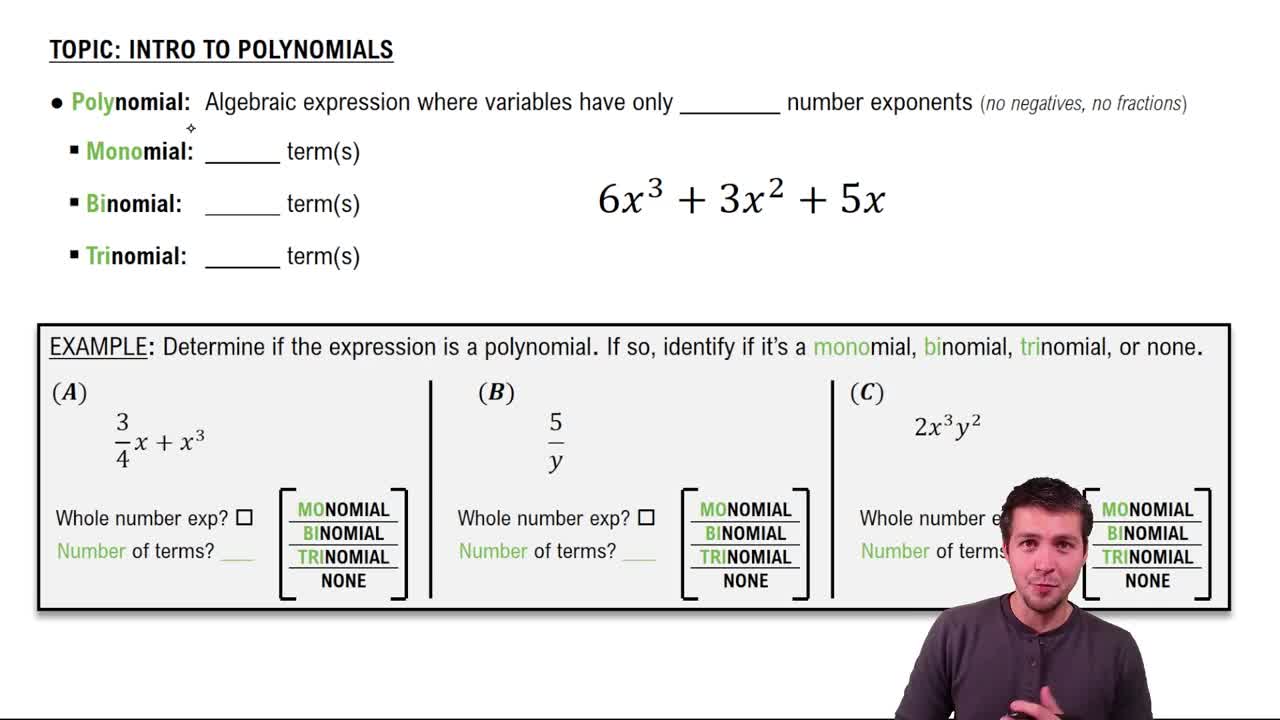
Polynomial expansion involves multiplying out expressions like (x + h)² to rewrite them as a sum of terms. For example, (x + h)² expands to x² + 2xh + h². This step is essential to simplify and combine like terms in the given expression.
Recommended video:
Guided course
05:13
Introduction to Polynomials

Combining Like Terms

Combining like terms means adding or subtracting terms with the same variable and exponent. After expanding, terms such as x², x, and constants are grouped together to simplify the expression into a more manageable form.
Recommended video:
5:22
Combinations

Distributive Property

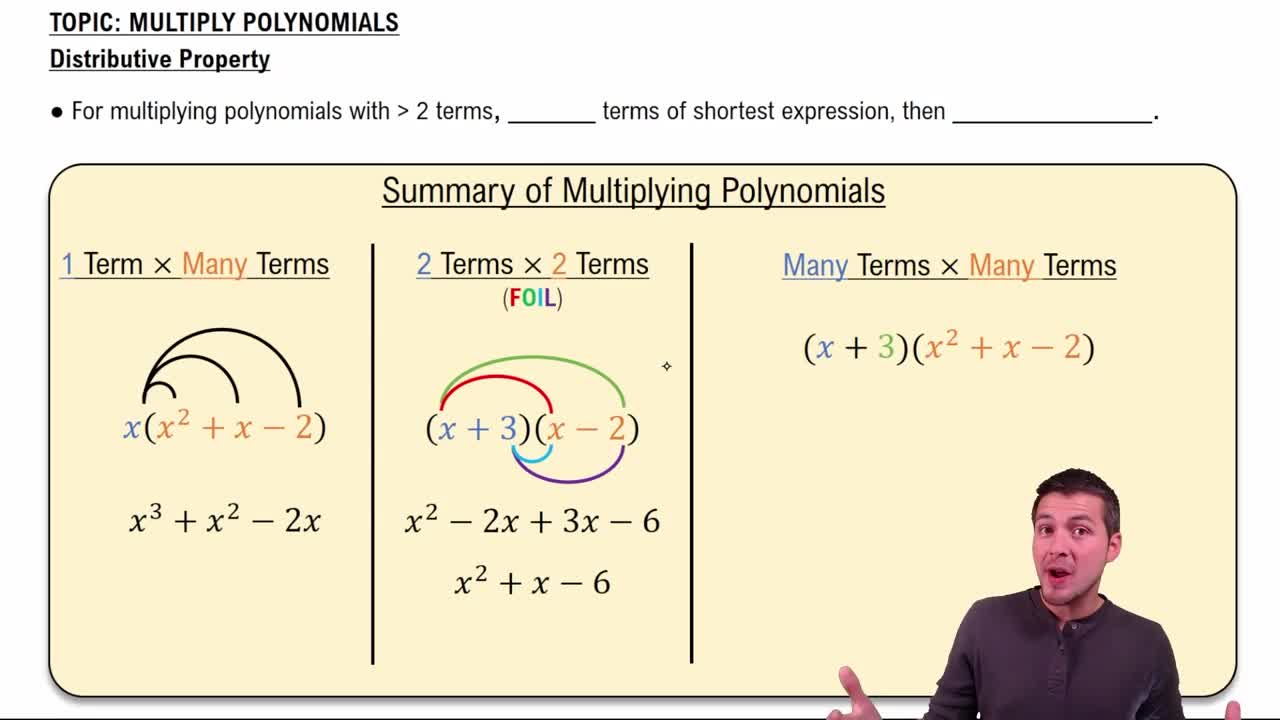
The distributive property allows multiplication over addition or subtraction, such as multiplying 2 by each term inside (x + h)². This property is used to remove parentheses and simplify expressions step-by-step.
Recommended video:
Guided course
04:15
Multiply Polynomials Using the Distributive Property