Give the center and radius of the circle described by the equation and graph each equation. Use the graph to identify the relation's domain and range. (x+3)² + (y - 2)² = 4
Ch. 2 - Functions and Graphs

Chapter 3, Problem 45
After a 30% price reduction, you purchase a 50″ 4K UHD TV for \$245. What was the television's price before the reduction?
Verified step by step guidance1
Let the original price of the television be represented by the variable \(P\).
Since the price was reduced by 30%, the sale price is 70% of the original price. This can be written as the equation: \(0.70 \times P = 245\).
To find the original price \(P\), divide both sides of the equation by 0.70: \(P = \frac{245}{0.70}\).
Simplify the right side of the equation to express \(P\) in terms of a numerical value (do not calculate the final number).
The result from the previous step will give you the original price of the television before the 30% reduction.

Verified video answer for a similar problem:
This video solution was recommended by our tutors as helpful for the problem above.
Video duration:
2mWas this helpful?
Key Concepts
Here are the essential concepts you must grasp in order to answer the question correctly.
Percentage Decrease
A percentage decrease represents how much a quantity is reduced relative to its original amount, expressed as a percent. In this problem, a 30% price reduction means the new price is 70% of the original price, since 100% - 30% = 70%.
Recommended video:
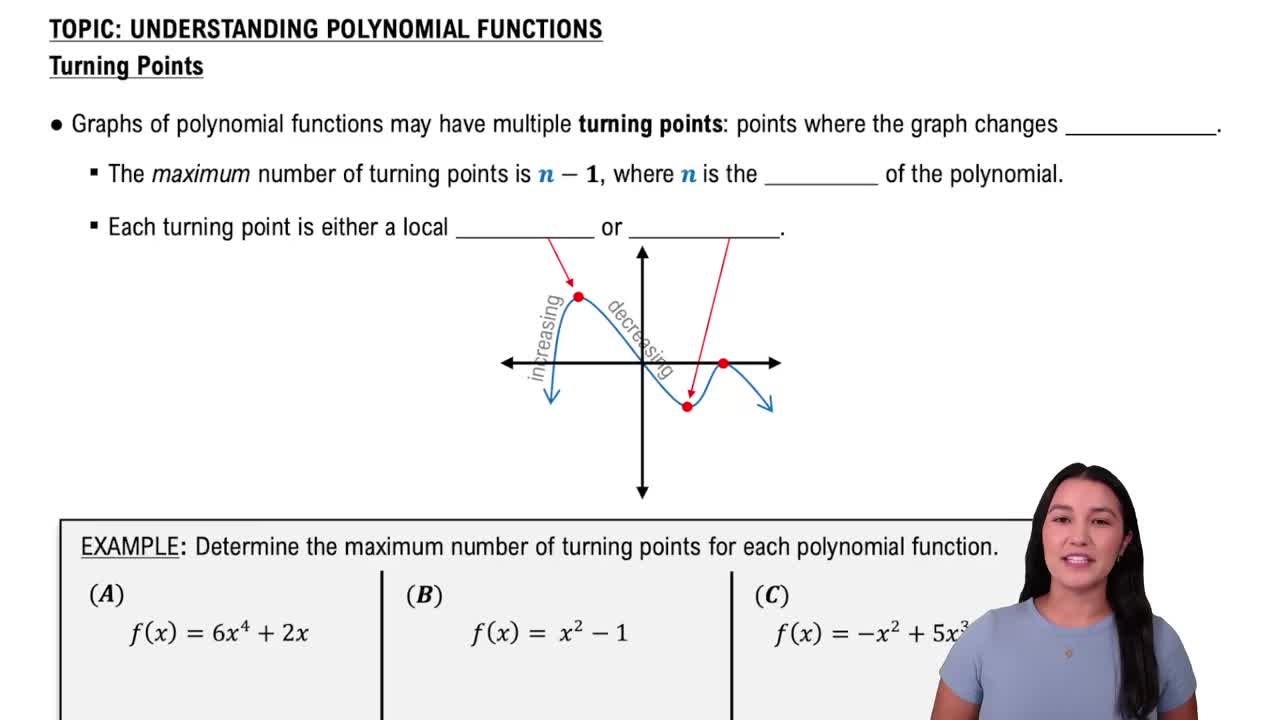
Maximum Turning Points of a Polynomial Function
Original Price Calculation
To find the original price before a percentage decrease, divide the reduced price by the remaining percentage (expressed as a decimal). Here, dividing $245 by 0.70 gives the original price before the 30% reduction.
Recommended video:
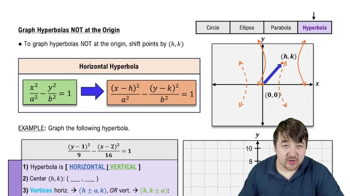
Graph Hyperbolas NOT at the Origin
Decimal and Percentage Conversion
Percentages are often converted to decimals for calculations by dividing by 100. For example, 30% becomes 0.30, and 70% becomes 0.70. This conversion is essential for multiplying or dividing when solving percentage problems.
Recommended video:
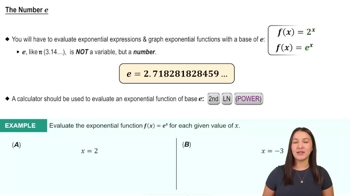
The Number e
Related Practice
Textbook Question
820
views
Textbook Question
In Exercises 39-52, a. Find an equation for ƒ¯¹(x). b. Graph ƒ and ƒ¯¹(x) in the same rectangular coordinate system. c. Use interval notation to give the domain and the range off and ƒ¯¹. f(x) = x³ − 1
612
views
Textbook Question
Find ƒ+g and determine the domain for each function. f(x)= = 8x/(x - 2), g(x) = 6/(x+3)
896
views
Textbook Question
Graph the given functions, f and g, in the same rectangular coordinate system. Select integers for x, starting with -2 and ending with 2. Once you have obtained your graphs, describe how the graph of g is related to the graph of f. f(x) = |x|, g(x) = |x| − 2
190
views
Textbook Question
Use the graph of y = f(x) to graph each function g. g(x) = f(x-1) – 1
894
views
Textbook Question
Find f−g and determine the domain for each function. f(x)= = 8x/(x - 2), g(x) = 6/(x+3)
885
views