Give the center and radius of the circle described by the equation and graph each equation. Use the graph to identify the relation's domain and range. (x − 3)² + (y + 1)² = 36
Ch. 2 - Functions and Graphs

Chapter 3, Problem 43abc
In Exercises 39-52, a. Find an equation for ƒ¯¹(x). b. Graph ƒ and ƒ¯¹(x) in the same rectangular coordinate system. c. Use interval notation to give the domain and the range off and ƒ¯¹. f(x) = (x − 1)², x ≤ 1
Verified step by step guidance1
Step 1: To find the inverse function ƒ¯¹(x), start by replacing f(x) with y. So, rewrite the given function as y = (x - 1)², where x ≤ 1.
Step 2: Swap x and y to begin solving for the inverse. This gives x = (y - 1)². Now, solve for y by taking the square root of both sides, keeping in mind the restriction x ≤ 1, which affects the sign of the square root.
Step 3: Solve for y by isolating it. Take the negative square root (since x ≤ 1 implies the function is decreasing) and then add 1 to both sides. This gives y = 1 - √x. Replace y with ƒ¯¹(x) to express the inverse function.
Step 4: To graph ƒ(x) and ƒ¯¹(x) on the same coordinate system, plot the parabola f(x) = (x - 1)² for x ≤ 1 and the inverse function ƒ¯¹(x) = 1 - √x. Remember that the graph of a function and its inverse are reflections of each other across the line y = x.
Step 5: Determine the domain and range of both functions. For f(x), the domain is (-∞, 1] and the range is [0, ∞). For ƒ¯¹(x), the domain is [0, ∞) and the range is (-∞, 1]. Use interval notation to express these sets.

Verified video answer for a similar problem:
This video solution was recommended by our tutors as helpful for the problem above.
Video duration:
13mKey Concepts
Here are the essential concepts you must grasp in order to answer the question correctly.
Inverse Functions
An inverse function reverses the effect of the original function. For a function f(x), its inverse f¯¹(x) satisfies the condition f(f¯¹(x)) = x for all x in the domain of f¯¹. To find the inverse, one typically swaps the roles of x and y in the equation and solves for y. Understanding this concept is crucial for part (a) of the question.
Recommended video:
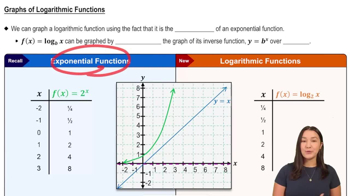
Graphing Logarithmic Functions
Graphing Functions
Graphing functions involves plotting points on a coordinate system to visually represent the relationship between the input (x) and output (f(x)). For the original function f(x) and its inverse f¯¹(x), their graphs will reflect across the line y = x. This symmetry is essential for part (b) of the question, as it helps in understanding how the two functions relate to each other.
Recommended video:
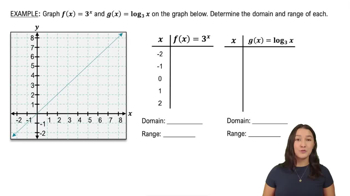
Graphs of Logarithmic Functions
Domain and Range
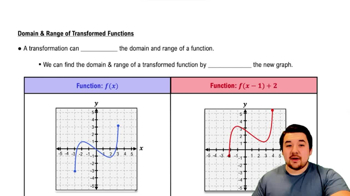
The domain of a function is the set of all possible input values (x-values), while the range is the set of all possible output values (f(x)). For the function f(x) = (x - 1)² with the restriction x ≤ 1, the domain is limited, affecting the range. Understanding how to express these sets in interval notation is necessary for part (c) of the question, as it provides a concise way to describe the function's behavior.
Recommended video:
Domain & Range of Transformed Functions
Related Practice
Textbook Question
811
views
Textbook Question
Find f/g and determine the domain for each function. f(x)= = (5x+1)/(x² - 9), g(x) = (4x -2)/(x² - 9)
1239
views
Textbook Question
Find f−g and determine the domain for each function. f(x)= = (5x+1)/(x² - 9), g(x) = (4x -2)/(x² - 9)
1195
views
Textbook Question
Find ƒ+g and determine the domain for each function.
f(x)= = (5x+1)/(x² - 9), g(x) = (4x -2)/(x² - 9)
914
views
Textbook Question
Find fg and determine the domain for each function. f(x)= = (5x+1)/(x² - 9), g(x) = (4x -2)/(x² - 9)
1289
views
Textbook Question
In Exercises 41–44, use the given conditions to write an equation for each line in point-slope form and slope-intercept form. Passing through (4, -7) and parallel to the line whose equation is 3x + y - 9 = 0.
305
views