Using standard reduction potentials (Appendix E), calculate the standard emf for each of the following reactions: (c) Fe1s2 + 2 Fe3+1aq2 ¡ 3 Fe2+1aq2
Ch.20 - Electrochemistry

Brown15th EditionChemistry: The Central ScienceISBN: 9780137542970Not the one you use?Change textbook
Chapter 20, Problem 41d
Using standard reduction potentials (Appendix E), calculate the standard emf for each of the following reactions: (d) 2 NO3-1aq2 + 8 H+1aq2 + 3 Cu1s2 ¡ 2 NO1g2 + 4 H2O1l2 + 3 Cu2+1aq2
Verified step by step guidance1
Identify the half-reactions involved in the overall reaction. For this reaction, the two half-reactions are the reduction of \( \text{NO}_3^- \) to \( \text{NO} \) and the oxidation of \( \text{Cu} \) to \( \text{Cu}^{2+} \).
Write the reduction half-reaction: \( \text{NO}_3^- + 4\text{H}^+ + 3e^- \rightarrow \text{NO} + 2\text{H}_2\text{O} \).
Write the oxidation half-reaction: \( \text{Cu} \rightarrow \text{Cu}^{2+} + 2e^- \).
Look up the standard reduction potentials for each half-reaction in Appendix E. The standard reduction potential for \( \text{NO}_3^- \) to \( \text{NO} \) is typically given, and the standard reduction potential for \( \text{Cu}^{2+} \) to \( \text{Cu} \) is also available.
Calculate the standard emf (\( E^\circ_{\text{cell}} \)) by using the formula: \( E^\circ_{\text{cell}} = E^\circ_{\text{cathode}} - E^\circ_{\text{anode}} \), where the cathode is the reduction half-reaction and the anode is the oxidation half-reaction.

Verified video answer for a similar problem:
This video solution was recommended by our tutors as helpful for the problem above.
Video duration:
4mWas this helpful?
Key Concepts
Here are the essential concepts you must grasp in order to answer the question correctly.
Standard Reduction Potentials
Standard reduction potentials are measured voltages that indicate the tendency of a chemical species to gain electrons and be reduced. Each half-reaction has a specific potential, and these values are typically listed in tables. The more positive the potential, the greater the species' ability to be reduced. These values are crucial for calculating the overall cell potential in electrochemical reactions.
Recommended video:
Guided course
Standard Reduction Potentials
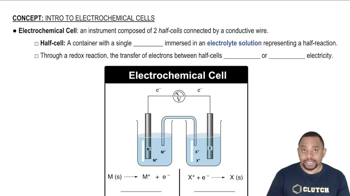
Electrochemical Cell and EMF
An electrochemical cell consists of two half-cells where oxidation and reduction reactions occur. The electromotive force (EMF) is the voltage generated by the cell when no current is flowing, representing the maximum potential difference between the two electrodes. The standard EMF can be calculated using the standard reduction potentials of the half-reactions involved, following the equation: EMF = E(cathode) - E(anode).
Balancing Redox Reactions
Balancing redox reactions involves ensuring that both mass and charge are conserved in the reaction. This process includes identifying oxidation and reduction half-reactions, balancing the number of electrons transferred, and adjusting coefficients for reactants and products. Properly balanced reactions are essential for accurate calculations of standard EMF and understanding the stoichiometry of the overall reaction.
Related Practice
Textbook Question
335
views
Textbook Question
The standard reduction potentials of the following halfreactions are given in Appendix E:
Ag+(aq) + e- → Ag(s)
Cu2+(aq) + 2 e- → Cu(s)
Ni2+(aq) + 2 e- → Ni(s)
Cr3+(aq) + 3 e- → Cr(s)
(a) Determine which combination of these half-cell reactions leads to the cell reaction with the largest positive cell potential and calculate the value.
(b) Determine which combination of these half-cell reactions leads to the cell reaction with the smallest positive cell potential and calculate the value.
964
views
Textbook Question
A voltaic cell that uses the reaction PdCl42-(aq) + Cd(s) → Pd(s) + 4 Cl-(aq) + Cd2+(aq) has a measured standard cell potential of +1.03 V. (c) Sketch the voltaic cell, label the anode and cathode, and indicate the direction of electron flow