Give descriptions for the following terms: Nucleosome
Verified step by step guidance
1
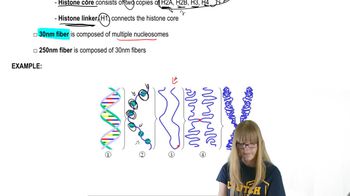
A nucleosome is the fundamental unit of chromatin structure in eukaryotic cells, responsible for packaging DNA into a compact form.
It consists of a segment of DNA wrapped around a core of histone proteins. Specifically, the DNA wraps approximately 1.65 turns around the histone octamer.
The histone octamer is composed of eight histone proteins: two copies each of H2A, H2B, H3, and H4.
Linker DNA connects adjacent nucleosomes, and the histone H1 protein helps stabilize the structure by binding to the linker DNA and the nucleosome core.
Nucleosomes play a critical role in regulating gene expression by controlling the accessibility of DNA to transcription factors and other proteins involved in gene regulation.
Verified video answer for a similar problem:
This video solution was recommended by our tutors as helpful for the problem above
Video duration:
3m
Play a video:
Was this helpful?
Key Concepts
Here are the essential concepts you must grasp in order to answer the question correctly.
Nucleosome Structure
A nucleosome is the fundamental unit of chromatin, consisting of a segment of DNA wrapped around a core of histone proteins. This structure resembles 'beads on a string,' where the DNA is the string and the nucleosomes are the beads. Each nucleosome typically contains about 147 base pairs of DNA and is crucial for the compaction of DNA within the nucleus.
Nucleosomes play a significant role in gene regulation by controlling access to DNA. The positioning and modification of nucleosomes can either expose or obscure specific gene regions, influencing transcription. This dynamic regulation is essential for cellular differentiation and response to environmental signals.
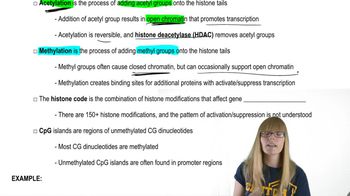
Histone proteins within nucleosomes can undergo various post-translational modifications, such as acetylation, methylation, and phosphorylation. These modifications can alter the interaction between DNA and histones, affecting chromatin structure and function. Such changes are critical for processes like DNA repair, replication, and transcriptional activation or repression.