Pearson+ LogoPearson+ Logo
Ch. 10 - Eukaryotic Chromosome Abnormalities and Molecular Organization
Sanders - Genetic Analysis: An Integrated Approach 3rd Edition
Sanders3rd EditionGenetic Analysis: An Integrated ApproachISBN: 9780135564172Not the one you use?Change textbook
Chapter 10, Problem 3a

In eukaryotic DNA, where are you most likely to find histone protein H4?

Verified step by step guidance
1
Understand that histone proteins, including H4, are part of the nucleosome structure in eukaryotic DNA. Nucleosomes are the basic units of chromatin, which help in DNA packaging.
Recall that a nucleosome consists of DNA wrapped around a core of histone proteins. This core is made up of two copies each of histones H2A, H2B, H3, and H4.
Recognize that histone H4 is one of the core histones and is located in the nucleosome core, where it interacts with DNA and other histones to stabilize the structure.
Note that histone H4 is specifically involved in forming the histone octamer and plays a role in the tight wrapping of DNA around the nucleosome.
Conclude that histone H4 is most likely to be found in the nucleosome core, tightly associated with DNA in eukaryotic chromatin.

Verified video answer for a similar problem:

This video solution was recommended by our tutors as helpful for the problem above.
Video duration:
2m
Was this helpful?

Key Concepts

Here are the essential concepts you must grasp in order to answer the question correctly.

Eukaryotic DNA Structure

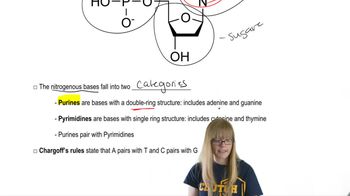
Eukaryotic DNA is organized into a complex structure known as chromatin, which consists of DNA wrapped around histone proteins. This organization allows for efficient packaging of DNA within the nucleus and plays a crucial role in gene regulation and expression.
Recommended video:
Guided course
06:25
DNA Structure

Histone Proteins

Histone proteins are a family of basic proteins that help package and order DNA into structural units called nucleosomes. Each nucleosome consists of a segment of DNA wound around a core of histone proteins, including H4, which is essential for maintaining the structural integrity of chromatin.
Recommended video:

Nucleosome Formation

Nucleosomes are the fundamental units of chromatin, formed by the wrapping of DNA around a histone octamer, which includes two copies of H2A, H2B, H3, and H4. This formation is critical for DNA compaction and regulation, as it influences access to genetic information during processes like transcription and replication.
Recommended video:
Guided course
04:06
Formation of Plant Gametes