Describe the roles and relationships between tRNA synthetases and tRNA molecules.
Verified step by step guidance
1
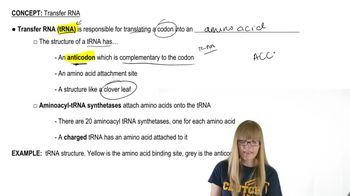
Understand that tRNA (transfer RNA) molecules are responsible for carrying specific amino acids to the ribosome during protein synthesis, where they match their anticodon with the codon on mRNA.
Learn that tRNA synthetases, also known as aminoacyl-tRNA synthetases, are enzymes that play a critical role in attaching the correct amino acid to its corresponding tRNA molecule. This process is called 'tRNA charging' or 'aminoacylation.'
Recognize that each tRNA synthetase is specific to one amino acid and its corresponding tRNA(s). There are 20 different tRNA synthetases, one for each amino acid.
Explore the two-step process of aminoacylation: (1) The tRNA synthetase activates the amino acid by attaching it to an adenosine monophosphate (AMP) molecule, forming an aminoacyl-AMP intermediate. (2) The activated amino acid is then transferred to the 3' end of the tRNA molecule, forming an aminoacyl-tRNA.
Understand the importance of the specificity of tRNA synthetases, as errors in attaching the wrong amino acid to a tRNA can lead to the incorporation of incorrect amino acids into proteins, potentially disrupting their structure and function.
Verified video answer for a similar problem:
This video solution was recommended by our tutors as helpful for the problem above
Video duration:
2m
Play a video:
Was this helpful?
Key Concepts
Here are the essential concepts you must grasp in order to answer the question correctly.
tRNA Molecules
Transfer RNA (tRNA) molecules are essential components of the protein synthesis machinery in cells. They serve as adapters that translate the genetic code carried by messenger RNA (mRNA) into specific amino acids during translation. Each tRNA molecule has a specific anticodon that pairs with a corresponding codon on the mRNA, ensuring the correct amino acid is added to the growing polypeptide chain.
tRNA synthetases are a group of enzymes responsible for charging tRNA molecules with their corresponding amino acids. Each synthetase is specific to one amino acid and its associated tRNA(s), ensuring that the correct amino acid is linked to the appropriate tRNA. This process, known as aminoacylation, is crucial for accurate protein synthesis, as it directly influences the fidelity of translation.
Aminoacylation is the process by which an amino acid is covalently attached to its corresponding tRNA molecule by a tRNA synthetase. This reaction is vital for the translation process, as it activates the amino acid for incorporation into a polypeptide chain. The accuracy of aminoacylation is critical, as errors can lead to the incorporation of incorrect amino acids, potentially resulting in dysfunctional proteins.