Pearson+ LogoPearson+ Logo
Ch. 9 - The Molecular Biology of Translation
Sanders - Genetic Analysis: An Integrated Approach 3rd Edition
Sanders3rd EditionGenetic Analysis: An Integrated ApproachISBN: 9780135564172Not the one you use?Change textbook
Chapter 9, Problem 21b

In an experiment to decipher the genetic code, a poly-AC mRNA (ACACACAC...) is synthesized. What pattern of amino acids would appear if this sequence were to be translated by a mechanism that reads the genetic code as
A doublet with overlaps?

Verified step by step guidance
1
Understand the problem: The poly-AC mRNA sequence (ACACACAC...) is being translated using a hypothetical mechanism that reads the genetic code as doublets with overlaps. This means that the ribosome reads two nucleotides at a time, and each doublet overlaps with the previous one by one nucleotide.
Identify the sequence of doublets: Since the mRNA sequence is ACACACAC..., the overlapping doublets would be: AC, CA, AC, CA, and so on. This pattern repeats throughout the sequence.
Determine the amino acids encoded by each doublet: Use a genetic code table that maps doublets to amino acids (note: this is hypothetical, as the real genetic code uses triplets). For example, if AC codes for one amino acid and CA codes for another, identify these amino acids.
Analyze the pattern of amino acids: Since the sequence alternates between AC and CA, the resulting amino acid sequence would alternate between the amino acids encoded by AC and CA. This creates a repeating pattern.
Summarize the findings: The translation of the poly-AC mRNA sequence using a doublet mechanism with overlaps would produce a repeating pattern of two amino acids, corresponding to the doublets AC and CA.

Verified video answer for a similar problem:

This video solution was recommended by our tutors as helpful for the problem above.
Video duration:
2m
Was this helpful?

Key Concepts

Here are the essential concepts you must grasp in order to answer the question correctly.

Genetic Code

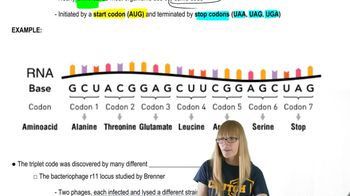
The genetic code is a set of rules that defines how sequences of nucleotides in DNA and RNA are translated into amino acids, the building blocks of proteins. It consists of codons, which are triplets of nucleotides, each corresponding to a specific amino acid. Understanding the genetic code is essential for predicting the amino acid sequence from a given mRNA.
Recommended video:
Guided course
11:43
The Genetic Code

Translation Mechanism

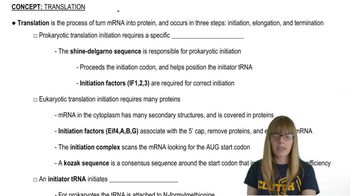
Translation is the process by which ribosomes synthesize proteins using mRNA as a template. In this context, the mechanism that reads the genetic code as a doublet with overlaps means that the ribosome reads two nucleotides at a time, potentially overlapping the reading frames. This approach can lead to different amino acid sequences than the standard triplet reading.
Recommended video:
Guided course
07:58
Translation initiation

Overlapping Codons

Overlapping codons occur when the reading frame of the genetic code allows for the same nucleotide sequence to be interpreted in multiple ways. In the case of doublet reading, each pair of nucleotides can form a codon that overlaps with the next, creating a unique pattern of amino acids. This concept is crucial for understanding how variations in reading frames can affect protein synthesis.
Recommended video:
Guided course
11:43
The Genetic Code