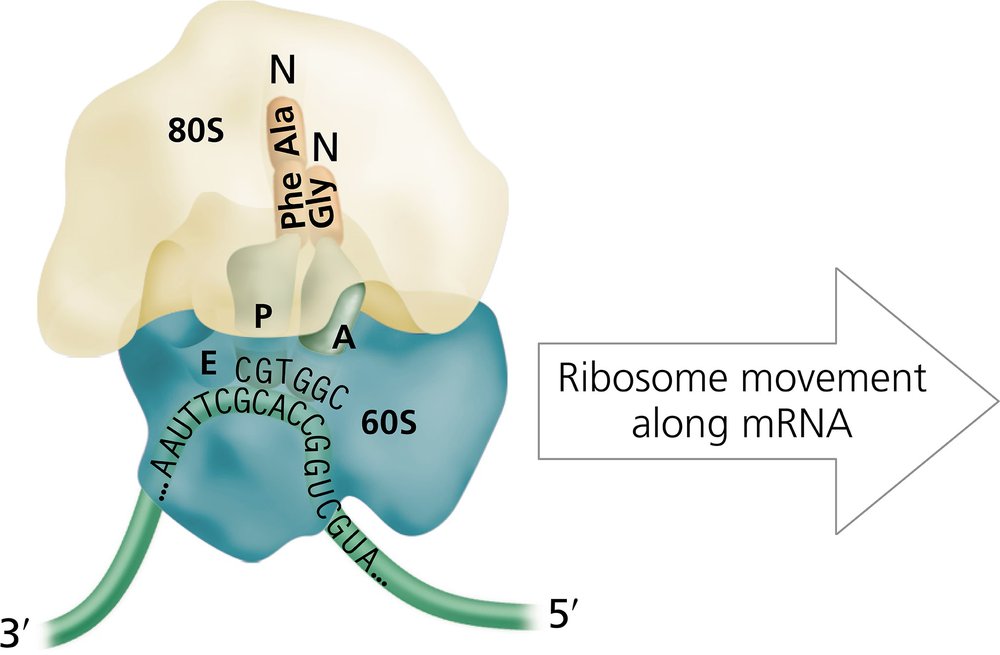
The diagram of a eukaryotic ribosome shown below contains several errors. Redraw the diagram, and correct each error using the mRNA sequence shown.
Verified step by step guidance
1
Identify the errors in the provided eukaryotic ribosome diagram. Common errors might include incorrect labeling of ribosomal subunits, misplacement of mRNA, tRNA, or codons, or incorrect orientation of the ribosome components.
Review the mRNA sequence provided in the problem. Ensure that the sequence is correctly oriented (5' to 3') and matches the direction of translation in a eukaryotic ribosome.
Redraw the ribosome diagram, ensuring that the large (60S) and small (40S) subunits are correctly labeled and positioned. The mRNA should pass through the small subunit, with the start codon (AUG) positioned in the P site.
Correctly position the tRNA molecules in the ribosome. The tRNA carrying methionine (initiator tRNA) should be in the P site, and the next tRNA should align with the codon in the A site.
Ensure that the ribosome diagram reflects the correct translation process, including the direction of movement (5' to 3') and the proper alignment of codons, anticodons, and amino acids being added to the growing polypeptide chain.
Verified video answer for a similar problem:
This video solution was recommended by our tutors as helpful for the problem above
Video duration:
3m
Play a video:
Was this helpful?
Key Concepts
Here are the essential concepts you must grasp in order to answer the question correctly.
Eukaryotic Ribosome Structure
Eukaryotic ribosomes are complex molecular machines composed of ribosomal RNA (rRNA) and proteins. They consist of two subunits: the large subunit (60S) and the small subunit (40S). These subunits come together during protein synthesis to translate mRNA into polypeptides, ensuring accurate reading of the genetic code.
Messenger RNA (mRNA) is a single-stranded molecule that carries genetic information from DNA to the ribosome for protein synthesis. The mRNA sequence is read in sets of three nucleotides called codons, each of which corresponds to a specific amino acid. Understanding the codon sequence is crucial for accurately translating the mRNA into a functional protein.
Translation is the process by which ribosomes synthesize proteins using the information encoded in mRNA. It involves three main stages: initiation, elongation, and termination. During this process, tRNA molecules bring amino acids to the ribosome, matching their anticodons with the mRNA codons, ultimately forming a polypeptide chain that folds into a functional protein.