Pearson+ LogoPearson+ Logo
Ch. 9 - The Molecular Biology of Translation
Sanders - Genetic Analysis: An Integrated Approach 3rd Edition
Sanders3rd EditionGenetic Analysis: An Integrated ApproachISBN: 9780135564172Not the one you use?Change textbook
Chapter 9, Problem 13b

Third-base wobble allows some tRNAs to recognize more than one mRNA codon. Based on this chapter's discussion of wobble, what is the minimal number of tRNA molecules necessary to recognize the following amino acids?
Arginine

Verified step by step guidance
1
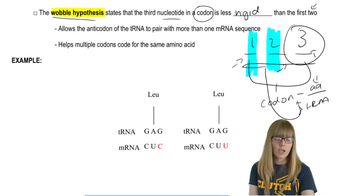
Understand the concept of wobble: Wobble refers to the flexibility in base pairing at the third position of the codon, allowing a single tRNA to recognize multiple codons. This is due to non-standard base pairing rules at this position.
Identify the codons for arginine: Arginine is encoded by six codons: CGU, CGC, CGA, CGG, AGA, and AGG. These codons are grouped based on their similarities in the first two positions.
Group the codons based on wobble rules: The first four codons (CGU, CGC, CGA, CGG) share the same first two bases (C and G), while the last two codons (AGA and AGG) share the first two bases (A and G). This grouping helps determine how many tRNAs are needed.
Determine the minimal number of tRNAs: For the first group (CGU, CGC, CGA, CGG), a single tRNA with an anticodon complementary to CGN (where N represents any base) can recognize all four codons due to wobble. For the second group (AGA and AGG), another tRNA with an anticodon complementary to AGN can recognize both codons.
Conclude the solution: Based on wobble rules, the minimal number of tRNA molecules necessary to recognize all six codons for arginine is two.

Verified video answer for a similar problem:

This video solution was recommended by our tutors as helpful for the problem above.
Video duration:
1m
Was this helpful?

Key Concepts

Here are the essential concepts you must grasp in order to answer the question correctly.

Wobble Hypothesis

The wobble hypothesis explains how the third position of a codon can tolerate mismatches between the codon in mRNA and the corresponding anticodon in tRNA. This flexibility allows a single tRNA to pair with multiple codons that code for the same amino acid, thereby reducing the total number of tRNA molecules required for protein synthesis.
Recommended video:
Guided course
03:13
Translation:Wobble Hypothesis

Codons and Amino Acids

Codons are sequences of three nucleotides in mRNA that specify particular amino acids during protein synthesis. Each amino acid can be encoded by one or more codons, which is crucial for understanding how many tRNA molecules are needed to translate a given set of codons into proteins.
Recommended video:

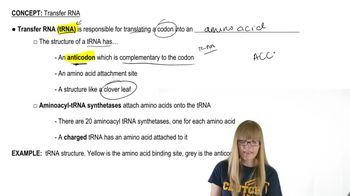
tRNA Molecules

Transfer RNA (tRNA) molecules are responsible for bringing the appropriate amino acids to the ribosome during translation. Each tRNA has a specific anticodon that pairs with a corresponding codon on the mRNA, and due to the wobble effect, fewer tRNA types can recognize multiple codons for the same amino acid, such as arginine.
Recommended video:
Related Practice