Pearson+ LogoPearson+ Logo
Ch. 7 - DNA Structure and Replication
Sanders - Genetic Analysis: An Integrated Approach 3rd Edition
Sanders3rd EditionGenetic Analysis: An Integrated ApproachISBN: 9780135564172Not the one you use?Change textbook
Chapter 7, Problem 11a

There is a problem completing the replication of linear chromosomes at their ends. Describe the problem and identify why telomeres shorten in each replication cycle.

Verified step by step guidance
1
Understand the structure of linear chromosomes: Linear chromosomes have ends called telomeres, which are repetitive DNA sequences that protect the chromosome from degradation and prevent the loss of essential genetic information during replication.
Review the mechanism of DNA replication: DNA polymerase synthesizes new DNA strands in the 5' to 3' direction. However, it requires a primer to initiate synthesis and cannot fully replicate the very ends of the lagging strand due to the removal of the RNA primer.
Explain the end-replication problem: During replication, the RNA primer at the very end of the lagging strand is removed, but DNA polymerase cannot fill in the gap because there is no upstream DNA to provide a starting point. This results in the progressive shortening of the chromosome ends with each replication cycle.
Describe the role of telomeres: Telomeres act as a buffer zone, absorbing the loss of DNA sequences during replication. However, as cells divide repeatedly, telomeres become progressively shorter, eventually leading to cellular senescence or apoptosis when they reach a critically short length.
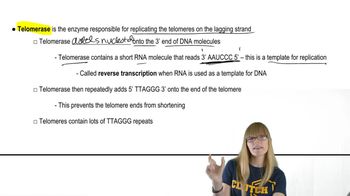
Introduce the enzyme telomerase: In certain cell types, such as germ cells and stem cells, the enzyme telomerase can extend telomeres by adding repetitive sequences to the ends of chromosomes, counteracting the shortening process and maintaining chromosome integrity.

Verified video answer for a similar problem:

This video solution was recommended by our tutors as helpful for the problem above.
Video duration:
2m
Was this helpful?

Key Concepts

Here are the essential concepts you must grasp in order to answer the question correctly.

Telomeres

Telomeres are repetitive nucleotide sequences located at the ends of linear chromosomes. They protect the chromosome from deterioration or fusion with neighboring chromosomes. Each time a cell divides, a portion of the telomere is not replicated, leading to gradual shortening over successive replication cycles.
Recommended video:
Guided course
08:38
Telomeres and Telomerase

DNA Replication

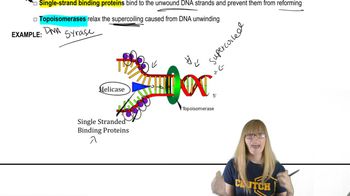
DNA replication is the process by which a cell duplicates its DNA before cell division. It involves unwinding the double helix and synthesizing new strands complementary to the original ones. However, due to the nature of DNA polymerase, which cannot fully replicate the ends of linear chromosomes, telomeres are progressively shortened with each replication.
Recommended video:
Guided course
11:59
Steps to DNA Replication

Hayflick Limit

The Hayflick limit refers to the number of times a normal somatic human cell can divide before cell division stops, which is typically around 40-60 divisions. This limit is largely due to telomere shortening, as critically short telomeres trigger cellular senescence or apoptosis, preventing further cell division and contributing to aging.
Recommended video:
Guided course
07:56
Sex-Linked Genes