DNA replication synthesizes DNA in which direction?
Table of contents
- 1. Introduction to Genetics51m
- 2. Mendel's Laws of Inheritance3h 37m
- 3. Extensions to Mendelian Inheritance2h 41m
- 4. Genetic Mapping and Linkage2h 28m
- 5. Genetics of Bacteria and Viruses1h 21m
- 6. Chromosomal Variation1h 48m
- 7. DNA and Chromosome Structure56m
- 8. DNA Replication1h 10m
- 9. Mitosis and Meiosis1h 34m
- 10. Transcription1h 0m
- 11. Translation58m
- 12. Gene Regulation in Prokaryotes1h 19m
- 13. Gene Regulation in Eukaryotes44m
- 14. Genetic Control of Development44m
- 15. Genomes and Genomics1h 50m
- 16. Transposable Elements47m
- 17. Mutation, Repair, and Recombination1h 6m
- 18. Molecular Genetic Tools19m
- 19. Cancer Genetics29m
- 20. Quantitative Genetics1h 26m
- 21. Population Genetics50m
- 22. Evolutionary Genetics29m
8. DNA Replication
Overview of DNA Replication
Problem 1e
Textbook Question
In the discussion, we focused on how DNA is replicated and synthesized. We also discussed recombination at the DNA level. Along the way, we encountered many opportunities to consider how this information was acquired. On the basis of these discussions, what answers would you propose to the following fundamental questions?
What observations reveal that a 'telomere problem' exists during eukaryotic DNA replication, and how did we learn of the solution to this problem?
Verified step by step guidance1
Step 1: Understand the 'telomere problem' by recognizing that during eukaryotic DNA replication, the ends of linear chromosomes (telomeres) cannot be fully replicated by DNA polymerase because it requires a primer and synthesizes DNA only in the 5' to 3' direction. This leads to progressive shortening of chromosomes with each cell division.
Step 2: Identify the key observations that revealed this problem, such as experiments showing that chromosome ends shorten after repeated rounds of DNA replication in somatic cells, and that this shortening correlates with cellular aging or senescence.
Step 3: Review how scientists discovered the solution by studying specialized structures at chromosome ends called telomeres, which consist of repetitive DNA sequences that protect coding regions from loss.
Step 4: Explore the discovery of the enzyme telomerase, which extends telomeres by adding repetitive sequences to the 3' end of chromosomes, thus compensating for the shortening that occurs during replication. This was learned through experiments in organisms like Tetrahymena and yeast, where telomerase activity was detected and linked to telomere maintenance.
Step 5: Summarize that the combination of molecular biology techniques, such as labeling newly synthesized DNA, genetic studies of mutants lacking telomerase, and biochemical assays, helped elucidate both the existence of the telomere problem and the mechanism by which telomerase solves it.
Verified video answer for a similar problem:This video solution was recommended by our tutors as helpful for the problem above
Video duration:
2mPlay a video:
Was this helpful?
Key Concepts
Here are the essential concepts you must grasp in order to answer the question correctly.
Telomere Structure and Function
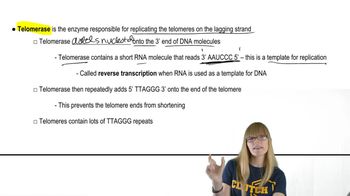
Telomeres are repetitive DNA sequences at the ends of eukaryotic chromosomes that protect them from degradation and prevent chromosome fusion. They act as protective caps, ensuring genome stability during cell division. Understanding their structure is essential to grasp why their replication poses a unique challenge.
Recommended video:
Guided course
Telomeres and Telomerase
The End-Replication Problem
During DNA replication, the lagging strand cannot be fully copied at the chromosome ends, leading to progressive shortening of telomeres with each cell division. This 'end-replication problem' was identified through observations of incomplete replication and chromosome shortening in eukaryotic cells.
Recommended video:
Guided course
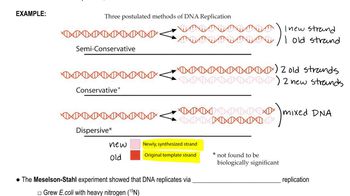
Semiconservative Replication
Telomerase and Its Discovery
Telomerase is a ribonucleoprotein enzyme that extends telomeres by adding repetitive sequences, solving the end-replication problem. Its discovery involved biochemical assays and genetic studies in organisms like Tetrahymena, revealing how cells maintain chromosome length and genomic integrity.
Recommended video:
Guided course
Telomeres and Telomerase
Related Videos
Related Practice
Multiple Choice
954
views
2
rank