Pearson+ LogoPearson+ Logo
Ch. 11 - DNA Replication and Recombination
Klug - Concepts of Genetics  12th Edition
Klug12th EditionConcepts of Genetics ISBN: 9780135564776Not the one you use?Change textbook
Chapter 11, Problem 4

Describe the role of ¹⁵N in the Meselson–Stahl experiment.

Verified step by step guidance
1
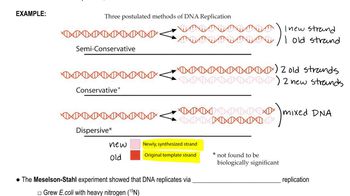
Understand that the Meselson–Stahl experiment was designed to determine the mechanism of DNA replication, specifically whether it is conservative, semi-conservative, or dispersive.
Recognize that ¹⁵N (nitrogen-15) is a heavy isotope of nitrogen used to label the DNA of bacteria by growing them in a medium containing ¹⁵N, which gets incorporated into the nitrogenous bases of DNA.
Note that after several generations in ¹⁵N medium, the DNA becomes 'heavy' due to the incorporation of ¹⁵N, allowing it to be distinguished from 'light' DNA containing the more common ¹⁴N isotope by density gradient centrifugation.
Observe that when bacteria are transferred from ¹⁵N medium to ¹⁴N medium and allowed to replicate, the distribution of DNA densities after replication can be analyzed to infer the replication mechanism.
Conclude that the role of ¹⁵N is to serve as a molecular marker that enables the separation and identification of DNA molecules based on their density, which is critical for interpreting the results of the Meselson–Stahl experiment.

Verified video answer for a similar problem:

This video solution was recommended by our tutors as helpful for the problem above.
Video duration:
1m
Was this helpful?

Key Concepts

Here are the essential concepts you must grasp in order to answer the question correctly.

Isotopic Labeling with ¹⁵N

¹⁵N is a stable heavy isotope of nitrogen used to label DNA molecules. In the Meselson–Stahl experiment, bacteria were grown in a medium containing ¹⁵N, causing their DNA to incorporate this heavier isotope, which allowed differentiation between old and new DNA strands based on density.
Recommended video:
Guided course
05:34
Bacteriophage Regulation

Density Gradient Centrifugation

This technique separates molecules based on their density by spinning them in a cesium chloride gradient. DNA containing ¹⁵N is denser and forms a distinct band lower in the gradient compared to DNA with the lighter ¹⁴N, enabling visualization of DNA replication patterns.
Recommended video:
Guided course
03:52
Cell-cell interactions

Semiconservative DNA Replication

The Meselson–Stahl experiment demonstrated that DNA replication is semiconservative, meaning each new DNA molecule consists of one old (¹⁵N-labeled) strand and one newly synthesized (¹⁴N) strand. The use of ¹⁵N allowed tracking of parental and daughter strands to confirm this model.
Recommended video:
Guided course
14:31
Semiconservative Replication