Pearson+ LogoPearson+ Logo
Ch. 9 - The Molecular Biology of Translation
Sanders - Genetic Analysis: An Integrated Approach 3rd Edition
Sanders3rd EditionGenetic Analysis: An Integrated ApproachISBN: 9780135564172Not the one you use?Change textbook
Chapter 9, Problem 42

For the sequences given in the following list, indicate whether DNA replication, transcription, pre-mRNA processing, or translation will be most immediately affected by deletion of the sequence. As precisely as you can, specify what step of the process is directly affected by the deletion.
a. start codon
b. TATA box
c. 5' splice site
d. ori sequence
e. -10 consensus sequence
f. Shine–Dalgarno sequence
g. 5' cap
h. termination sequence

Verified step by step guidance
1
Step 1: Understand the biological processes involved. DNA replication, transcription, pre-mRNA processing, and translation are distinct processes in gene expression. DNA replication involves copying the DNA, transcription involves synthesizing RNA from DNA, pre-mRNA processing modifies the RNA transcript, and translation synthesizes proteins from mRNA.
Step 2: Analyze each sequence and its role in the respective process. For example, the start codon is crucial for translation as it signals the beginning of protein synthesis. Deletion of the start codon would directly affect the initiation of translation.
Step 3: For the TATA box, recognize that it is a promoter sequence in transcription. It helps RNA polymerase bind to the DNA to initiate transcription. Deletion of the TATA box would disrupt the initiation of transcription.
Step 4: For the 5' splice site, understand that it is involved in pre-mRNA processing. It marks the boundary between an exon and an intron, and its deletion would affect RNA splicing, leading to improper removal of introns.
Step 5: Continue analyzing the remaining sequences (e.g., ori sequence, -10 consensus sequence, Shine–Dalgarno sequence, 5' cap, and termination sequence) by identifying their specific roles in DNA replication, transcription, pre-mRNA processing, or translation, and determine how their deletion would disrupt the respective process.

Verified video answer for a similar problem:

This video solution was recommended by our tutors as helpful for the problem above.
Video duration:
2m
Was this helpful?

Key Concepts

Here are the essential concepts you must grasp in order to answer the question correctly.

Start Codon

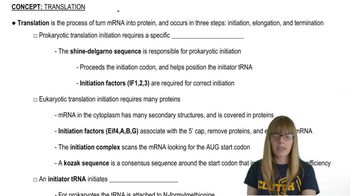
The start codon, typically AUG, is essential for initiating translation in protein synthesis. It signals the ribosome where to begin translating the mRNA into a polypeptide chain. Deletion of the start codon would prevent the ribosome from recognizing the beginning of the coding sequence, thereby halting translation.
Recommended video:
Guided course
07:58
Translation initiation

TATA Box

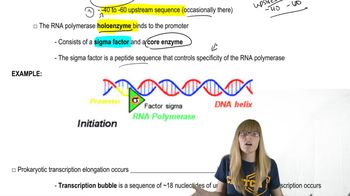
The TATA box is a DNA sequence found in the promoter region of genes, crucial for the initiation of transcription. It serves as a binding site for transcription factors and RNA polymerase, facilitating the unwinding of DNA and the start of RNA synthesis. Deletion of the TATA box would impair the transcription process, preventing the formation of mRNA.
Recommended video:
Guided course
10:14
Prokaryotic Transcription

5' Cap

The 5' cap is a modified guanine nucleotide added to the beginning of eukaryotic mRNA transcripts. It protects mRNA from degradation, aids in ribosome binding during translation, and is involved in the splicing process. Removal of the 5' cap would significantly affect mRNA stability and its ability to be translated efficiently.
Recommended video:
Guided course
06:55
Lac Operon Regulation