
Textbook Question
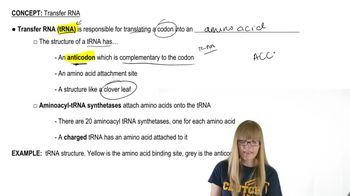
For each of the following tRNA anticodon sequences, give the sequence of the corresponding codon sequence, the amino acid carried by the tRNA, and the corresponding DNA coding strand sequence and polarity.
3′-UAC-5′
654
views

 Verified step by step guidance
 11:43
11:43
For each of the following tRNA anticodon sequences, give the sequence of the corresponding codon sequence, the amino acid carried by the tRNA, and the corresponding DNA coding strand sequence and polarity.
3′-UAC-5′
Answer the following questions about the accompanying diagram.
What process(es) are illustrated in the diagram?
Base-substitution mutations often change the amino acid specified by a codon. For each of the amino acid changes listed, determine which ones can result from a one–base-pair substitution. For those that can result from a one–base-pair substitution, give the possible wild-type and mutant codons, listing multiple possibilities if there is more than one option.
For each of the following tRNA anticodon sequences, give the sequence of the corresponding codon sequence, the amino acid carried by the tRNA, and the corresponding DNA coding strand sequence and polarity.
3′-AUG-5′
For the sequences given in the following list, indicate whether DNA replication, transcription, pre-mRNA processing, or translation will be most immediately affected by deletion of the sequence. As precisely as you can, specify what step of the process is directly affected by the deletion.
a. start codon
b. TATA box
c. 5' splice site
d. ori sequence
e. -10 consensus sequence
f. Shine–Dalgarno sequence
g. 5' cap
h. termination sequence
Answer the following questions about the accompanying diagram.
Does the diagram depict molecular activity in a bacterium or a eukaryote? Explain the reasoning for your answer.