Pearson+ LogoPearson+ Logo
Ch. 9 - The Molecular Biology of Translation
Sanders - Genetic Analysis: An Integrated Approach 3rd Edition
Sanders3rd EditionGenetic Analysis: An Integrated ApproachISBN: 9780135564172Not the one you use?Change textbook
Chapter 9, Problem 41

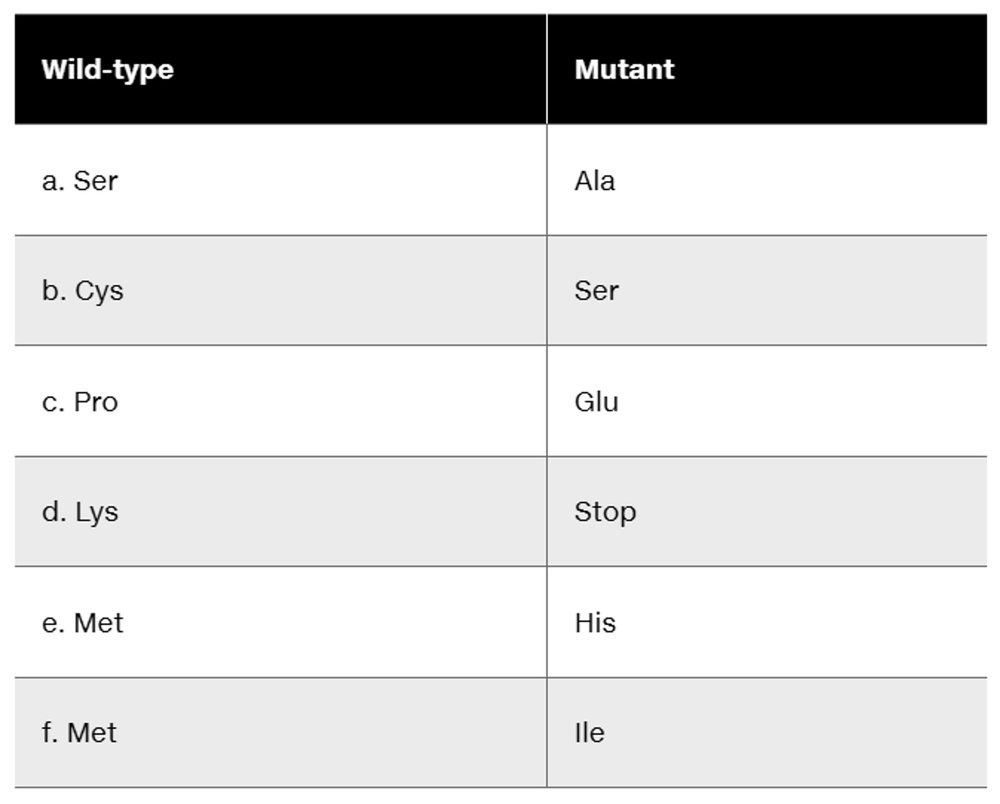
Base-substitution mutations often change the amino acid specified by a codon. For each of the amino acid changes listed, determine which ones can result from a one–base-pair substitution. For those that can result from a one–base-pair substitution, give the possible wild-type and mutant codons, listing multiple possibilities if there is more than one option.
Table comparing wild-type and mutant amino acids resulting from base-substitution mutations.

Verified step by step guidance
1
Step 1: Understand the problem. Base-substitution mutations involve a single nucleotide change in the DNA sequence, which can alter the codon and potentially change the amino acid it codes for. Use the genetic code table to identify codons for the wild-type and mutant amino acids.
Step 2: Analyze each amino acid change individually. For example, for part (a), identify all codons that code for Ser (wild-type) and Ala (mutant). Determine if a single nucleotide substitution can convert a Ser codon into an Ala codon.
Step 3: Repeat the process for each amino acid change listed (b through f). For each pair, identify the codons for the wild-type and mutant amino acids, and check if a one-base-pair substitution can result in the change. List all possible wild-type and mutant codon pairs.
Step 4: Use the genetic code table to verify your findings. Ensure that the codon changes are consistent with the rules of base substitution (e.g., transitions and transversions). Note that some amino acid changes may not be possible with a single base substitution.
Step 5: Summarize the results for each amino acid change, providing the possible wild-type and mutant codons for those changes that can occur due to a one-base-pair substitution. If a change is not possible, explain why based on the genetic code.

Verified video answer for a similar problem:

This video solution was recommended by our tutors as helpful for the problem above.
Video duration:
1m
Was this helpful?

Key Concepts

Here are the essential concepts you must grasp in order to answer the question correctly.

Base-Substitution Mutations

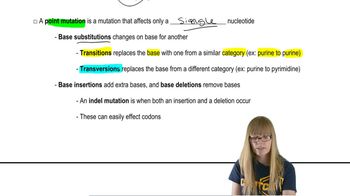
Base-substitution mutations occur when one nucleotide in the DNA sequence is replaced by another. This can lead to changes in the corresponding mRNA codon, potentially altering the amino acid specified during protein synthesis. Depending on the nature of the substitution, these mutations can be classified as silent, missense, or nonsense mutations, each having different effects on protein function.
Recommended video:
Guided course
03:49
Base Distortions

Genetic Code and Codons

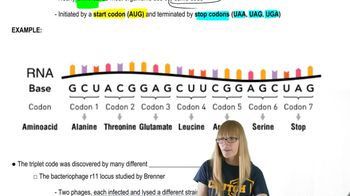
The genetic code consists of 64 codons, which are sequences of three nucleotides that correspond to specific amino acids or stop signals during protein synthesis. Understanding the genetic code is crucial for predicting how a base-substitution mutation might change an amino acid. Each amino acid can be encoded by multiple codons, a feature known as codon redundancy, which can influence the outcome of mutations.
Recommended video:
Guided course
11:43
The Genetic Code

Amino Acid Properties and Mutations

Amino acids have distinct properties that can affect protein structure and function. When a base-substitution mutation leads to a change in the amino acid sequence, it can result in a protein with altered characteristics, such as changes in charge, hydrophobicity, or size. This can have significant implications for the protein's activity, stability, and interactions within the cell.
Recommended video:
Guided course
09:49
Point Mutations