Pearson+ LogoPearson+ Logo
Ch. 15 - Recombinant DNA Technology and Its Applications
Sanders - Genetic Analysis: An Integrated Approach 3rd Edition
Sanders3rd EditionGenetic Analysis: An Integrated ApproachISBN: 9780135564172Not the one you use?Change textbook
Chapter 15, Problem 8

Compare methods for constructing homologous recombinant transgenic mice and yeast.

Verified step by step guidance
1
Identify the key components required for homologous recombination in both mice and yeast, such as the target gene, the vector containing the desired genetic modification, and the selection markers.
For transgenic mice, outline the process of creating a targeting vector that includes the desired genetic modification flanked by sequences homologous to the target gene. This vector is introduced into embryonic stem (ES) cells, where homologous recombination can occur.
Describe the process of selecting and screening ES cells that have undergone successful homologous recombination. This often involves using antibiotic resistance markers and PCR to confirm the presence of the desired modification.
Explain how the modified ES cells are injected into blastocysts, which are then implanted into surrogate mothers to develop into chimeric mice. These chimeras are bred to produce offspring that carry the genetic modification in their germline.
For yeast, discuss the use of a similar targeting vector, but highlight the differences in transformation techniques, such as the use of lithium acetate or electroporation, and the typically higher efficiency of homologous recombination in yeast compared to mice.

Verified video answer for a similar problem:

This video solution was recommended by our tutors as helpful for the problem above.
Video duration:
3m
Was this helpful?

Key Concepts

Here are the essential concepts you must grasp in order to answer the question correctly.

Homologous Recombination

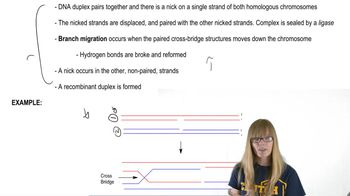
Homologous recombination is a genetic process where two similar or identical DNA sequences exchange genetic information. This mechanism is crucial for repairing DNA and is often exploited in genetic engineering to introduce specific changes in an organism's genome. In constructing transgenic organisms, such as mice and yeast, homologous recombination allows for precise insertion of desired genes, ensuring that the modifications are stable and heritable.
Recommended video:
Guided course
03:51
Recombination after Single Strand Breaks

Transgenic Organisms

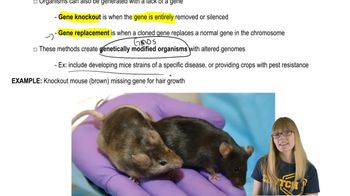
Transgenic organisms are those that have been genetically modified to contain DNA from another species. This is achieved through various techniques, including homologous recombination, which allows for the integration of foreign genes into the host genome. The creation of transgenic mice and yeast serves different purposes, such as studying gene function, producing proteins, or developing models for human diseases.
Recommended video:
Guided course
09:12
Transgenic Organisms and Gene Therapy

Gene Targeting Techniques

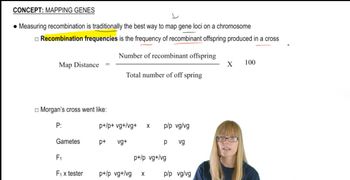
Gene targeting techniques are methods used to modify specific genes within an organism's genome. In mice, techniques like CRISPR/Cas9 and traditional homologous recombination are employed to create knockout or knock-in models. In yeast, similar strategies are used, but the simpler cellular structure allows for more straightforward manipulation. Understanding these techniques is essential for comparing the efficiency and outcomes of creating transgenic organisms in different species.
Recommended video:
Guided course
09:09
Mapping Genes
Related Practice
Textbook Question

The human genome is 3×10⁹ bp. You wish to design a primer to amplify a specific gene in the genome. In general, what length of oligonucleotide would be sufficient to amplify a single unique sequence? To simplify your calculation, assume that all bases occur with an equal frequency.

627
views
Textbook Question

Using animal models of human diseases can lead to insights into the cellular and genetic bases of the diseases. Duchenne muscular dystrophy (DMD) is the consequence of an X-linked recessive allele.

How would you make a mouse model of DMD?

613
views
Textbook Question

Using animal models of human diseases can lead to insights into the cellular and genetic bases of the diseases. Duchenne muscular dystrophy (DMD) is the consequence of an X-linked recessive allele.

How would you make a Drosophila model of DMD?

436
views
Textbook Question
Chimeric gene-fusion products can be used for medical or industrial purposes. One idea is to produce biological therapeutics for human medical use in animals from which the products can be easily harvested—in the milk of sheep or cattle, for example. Outline how you would produce human insulin in the milk of sheep.
492
views
Textbook Question
Why are diseases of the blood simpler targets for treatment by gene therapy than are many other genetic diseases?
440
views
Textbook Question

Injection of double-stranded RNA can lead to gene silencing by degradation of RNA molecules complementary to either strand of the dsRNA. Could RNAi be used in gene therapy for a defect caused by a recessive allele? A dominant allele? If so, what might be the major obstacle to using RNAi as a therapeutic agent?

578
views