Pearson+ LogoPearson+ Logo
Ch. 4 - Gene Interaction
Sanders - Genetic Analysis: An Integrated Approach 3rd Edition
Sanders3rd EditionGenetic Analysis: An Integrated ApproachISBN: 9780135564172Not the one you use?Change textbook
Chapter 4, Problem 1

Define and distinguish incomplete penetrance and variable expressivity.

Verified step by step guidance
1
Understand the concept of incomplete penetrance: Incomplete penetrance occurs when not all individuals with a particular genotype express the expected phenotype. For example, if a dominant allele is present but the phenotype is not observed in some individuals, this is incomplete penetrance.
Understand the concept of variable expressivity: Variable expressivity refers to the range of phenotypic expression among individuals with the same genotype. This means that while all individuals with the genotype express the phenotype, the severity or specific traits of the phenotype can vary.
Distinguish between the two concepts: Incomplete penetrance is about whether the phenotype is expressed at all (yes or no), while variable expressivity is about the degree or variation in the phenotype among those who do express it.
Consider examples to clarify: For incomplete penetrance, think of a genetic condition where some individuals with the mutation do not show symptoms. For variable expressivity, consider a condition like Marfan syndrome, where individuals may show a wide range of symptoms, from mild to severe.
Summarize the distinction: Incomplete penetrance is about the presence or absence of the phenotype, while variable expressivity is about the variability in the phenotype's manifestation among those who express it.

Verified video answer for a similar problem:

This video solution was recommended by our tutors as helpful for the problem above.
Video duration:
3m
Was this helpful?

Key Concepts

Here are the essential concepts you must grasp in order to answer the question correctly.

Incomplete Penetrance

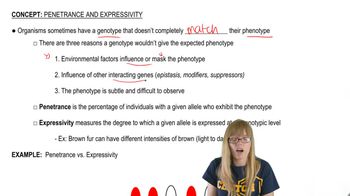
Incomplete penetrance refers to a situation where not all individuals with a specific genotype express the expected phenotype. This means that some individuals may carry a gene associated with a trait or disorder but do not exhibit any observable symptoms or characteristics. This phenomenon can be influenced by various factors, including environmental conditions and interactions with other genes.
Recommended video:
Guided course
02:09
Penetrance and Expressivity

Variable Expressivity

Variable expressivity describes the range of phenotypic expressions that can occur among individuals with the same genotype. Even if individuals share the same genetic mutation, they may display different degrees of severity or types of symptoms. This variability can be influenced by genetic background, environmental factors, and lifestyle choices, leading to a spectrum of manifestations of a genetic condition.
Recommended video:
Guided course
02:09
Penetrance and Expressivity

Genotype-Phenotype Relationship

The genotype-phenotype relationship is a fundamental concept in genetics that describes how genetic information (genotype) translates into observable traits (phenotype). Understanding this relationship is crucial for distinguishing between incomplete penetrance and variable expressivity, as both concepts highlight the complexity of how genetic factors can influence physical characteristics and health outcomes in individuals.
Recommended video:
Guided course
07:52
Gamete Genotypes