Pearson+ LogoPearson+ Logo
Ch. 4 - Gene Interaction
Sanders - Genetic Analysis: An Integrated Approach 3rd Edition
Sanders3rd EditionGenetic Analysis: An Integrated ApproachISBN: 9780135564172Not the one you use?Change textbook
Chapter 4, Problem 2

Define and distinguish epistasis and pleiotropy.

Verified step by step guidance
1
Epistasis refers to a genetic interaction where the expression of one gene is influenced or completely masked by another gene. For example, in coat color inheritance in Labrador retrievers, one gene determines pigment color (black or brown), while another gene determines whether pigment is deposited in the fur. If the second gene prevents pigment deposition, the coat appears yellow regardless of the first gene's alleles.
Pleiotropy occurs when a single gene influences multiple, seemingly unrelated phenotypic traits. For instance, the Marfan syndrome gene affects connective tissue, leading to a variety of symptoms such as long limbs, heart defects, and vision problems.
To distinguish between the two, note that epistasis involves interactions between two or more genes, where one gene's expression affects another's. In contrast, pleiotropy involves a single gene affecting multiple traits.
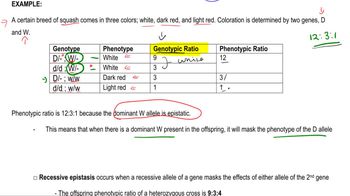
Epistasis is often studied in dihybrid crosses, where the phenotypic ratios deviate from the expected Mendelian ratios due to gene interactions. For example, a 9:3:3:1 ratio might shift to 9:7 or 12:3:1 depending on the type of epistasis.
Pleiotropy is typically identified through the observation of multiple phenotypic effects caused by mutations in a single gene. This is often studied in the context of genetic disorders or developmental biology.

Verified video answer for a similar problem:

This video solution was recommended by our tutors as helpful for the problem above.
Video duration:
59s
Was this helpful?

Key Concepts

Here are the essential concepts you must grasp in order to answer the question correctly.

Epistasis

Epistasis refers to the interaction between genes where the expression of one gene is affected by one or more other genes. This can result in a masking effect, where the phenotypic expression of a gene (the epistatic gene) overrides that of another gene (the hypostatic gene). For example, in coat color in mice, one gene can determine whether pigment is produced, while another gene can influence the type of pigment, demonstrating how gene interactions can shape phenotypes.
Recommended video:
Guided course
13:08
Epistatic Genes

Pleiotropy

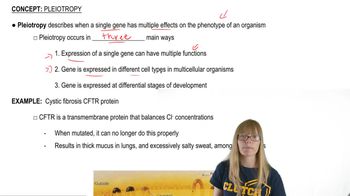
Pleiotropy occurs when a single gene influences multiple phenotypic traits. This means that a mutation in one gene can lead to various effects on an organism's phenotype, often seen in conditions like Marfan syndrome, where a single genetic defect affects the connective tissue, leading to diverse symptoms such as tall stature, heart problems, and long limbs. Understanding pleiotropy is crucial for grasping how genetic variations can have widespread effects.
Recommended video:

Distinction between Epistasis and Pleiotropy

The key distinction between epistasis and pleiotropy lies in their mechanisms of gene interaction. Epistasis involves the interaction between multiple genes affecting a single trait, while pleiotropy involves a single gene affecting multiple traits. Recognizing this difference is essential for understanding genetic pathways and how traits are inherited, as it influences the complexity of genetic interactions and the resulting phenotypic diversity.
Recommended video: