
Pearson+ LogoPearson+ Logo
Ch. 4 - Gene Interaction
Sanders - Genetic Analysis: An Integrated Approach 3rd Edition
Sanders3rd EditionGenetic Analysis: An Integrated ApproachISBN: 9780135564172Not the one you use?Change textbook
Chapter 4, Problem 38c

Draw a pedigree containing two parents and four children. Both of the parents have AB blood type. The first child is type A, the second child is type AB, and the third child is type B.
What is the name of the genetic phenomenon producing this observation?

Verified step by step guidance
1
Start by understanding the genetic basis of ABO blood types. The ABO blood group system is determined by a single gene (I) with three alleles: IA, IB, and i. IA and IB are codominant, meaning both are expressed when present together, while i is recessive.
Draw the pedigree chart. Represent the two parents at the top of the chart. Both parents have AB blood type, which means their genotypes are IAIB. Connect them with a horizontal line to indicate they are a couple.
Add four children below the parents, connected by vertical lines. Label the first child as blood type A, the second child as blood type AB, and the third child as blood type B. Leave the fourth child unassigned for now, as it is not mentioned in the problem.
Determine the possible genotypes of the children based on the parents' genotypes (IAIB). Use a Punnett square to calculate the probabilities of inheritance. The possible combinations are: IAIA (type A), IAIB (type AB), IBIB (type B), and IAi or IBi (type A or B, respectively). The observed blood types match these possibilities.
Explain the genetic phenomenon observed. The phenomenon is codominance, where both IA and IB alleles are expressed equally in individuals with the AB blood type. This explains why the second child has AB blood type and why the other children exhibit either A or B blood types depending on the inherited alleles.

Verified video answer for a similar problem:

This video solution was recommended by our tutors as helpful for the problem above.
Video duration:
1m
Was this helpful?

Key Concepts

Here are the essential concepts you must grasp in order to answer the question correctly.

Blood Type Inheritance

Blood type is determined by the ABO gene, which has three alleles: A, B, and O. Each person inherits one allele from each parent, resulting in four possible blood types: A, B, AB, and O. In this case, both parents with AB blood type can pass on either A or B alleles, leading to the observed blood types in their children.
Recommended video:
Guided course
00:36
Types of Maternal Inheritance

Codominance

Codominance is a genetic phenomenon where both alleles in a heterozygous individual are fully expressed, resulting in a phenotype that displays characteristics of both alleles. In the context of blood types, the AB blood type exemplifies codominance, as both A and B antigens are present on the red blood cells.
Recommended video:
Guided course
04:37
Variations on Dominance

Punnett Square

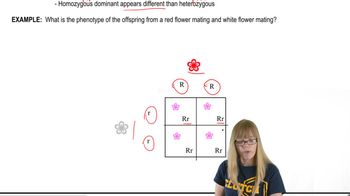
A Punnett square is a diagram used to predict the genetic outcomes of a cross between two individuals. By mapping the possible allele combinations from each parent, it helps visualize the probability of offspring inheriting specific traits, such as blood types in this scenario, aiding in understanding the inheritance patterns.
Recommended video:
Guided course
18:27
Chi Square Analysis