Determine whether the statements below are true or false. If a statement is false, provide the correct information or revise the statement to make it correct. A test cross between a heterozygous parent and a homozygous recessive parent is expected to produce a 1:1 genotypic and phenotypic ratio.
Verified step by step guidance
1
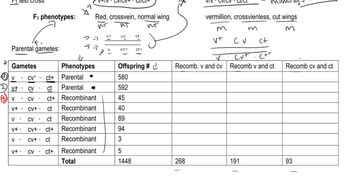
Understand the concept of a test cross: A test cross is performed to determine the genotype of an individual with a dominant phenotype by crossing it with a homozygous recessive individual.
Identify the genotypes involved: A heterozygous parent has the genotype Aa, where 'A' is the dominant allele and 'a' is the recessive allele. A homozygous recessive parent has the genotype aa.
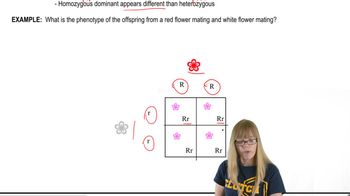
Set up the Punnett square: Place the alleles of the heterozygous parent (A and a) on one axis and the alleles of the homozygous recessive parent (a and a) on the other axis. Fill in the squares to determine the possible offspring genotypes.
Analyze the genotypic ratio: The Punnett square will show that the offspring genotypes are 50% Aa (heterozygous) and 50% aa (homozygous recessive), resulting in a 1:1 genotypic ratio.
Analyze the phenotypic ratio: Since 'A' is dominant, the Aa offspring will display the dominant phenotype, while the aa offspring will display the recessive phenotype. This also results in a 1:1 phenotypic ratio. Therefore, the statement is true.
Verified video answer for a similar problem:
This video solution was recommended by our tutors as helpful for the problem above
Video duration:
3m
Play a video:
Was this helpful?
Key Concepts
Here are the essential concepts you must grasp in order to answer the question correctly.
Test Cross
A test cross is a genetic cross performed to determine the genotype of an individual exhibiting a dominant phenotype. This is done by crossing the individual with a homozygous recessive individual. The offspring's phenotypes reveal the unknown genotype based on the ratios observed in the progeny.
Heterozygous refers to an organism that has two different alleles for a particular gene, while homozygous refers to an organism with two identical alleles. In the context of a test cross, a heterozygous parent (e.g., Aa) is crossed with a homozygous recessive parent (e.g., aa) to analyze the inheritance patterns of traits.
Genotypic ratios represent the relative frequencies of different genotypes in the offspring, while phenotypic ratios represent the relative frequencies of observable traits. In a test cross between a heterozygous and a homozygous recessive parent, the expected ratios are 1:1 for both genotypes (Aa:aa) and phenotypes (dominant:recessive), confirming the inheritance patterns.