Pearson+ LogoPearson+ Logo
Ch. 5 - Genetic Linkage and Mapping in Eukaryotes
Sanders - Genetic Analysis: An Integrated Approach 3rd Edition
Sanders3rd EditionGenetic Analysis: An Integrated ApproachISBN: 9780135564172Not the one you use?Change textbook
Chapter 5, Problem 17

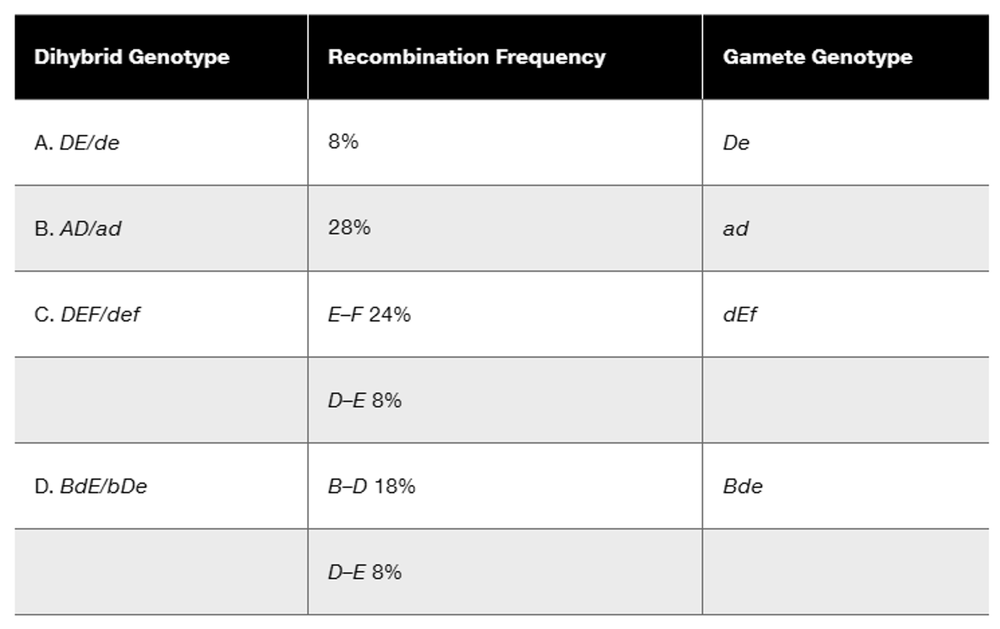
The table given here lists the arrangement of alleles of linked genes in dihybrid organisms, the recombination frequency between the genes, and specific gamete genotypes. Using the information provided, determine the expected frequency of the listed gametes. Assume one map unit equals 1% recombination and, when three genes are involved, interference is zero.
Table displaying dihybrid genotypes, recombination frequencies, and corresponding gamete genotypes for genetic mapping.

Verified step by step guidance
1
Step 1: Understand the concept of recombination frequency. Recombination frequency is expressed as a percentage and represents the likelihood of crossover events between linked genes during meiosis. One map unit corresponds to 1% recombination frequency.
Step 2: For each dihybrid genotype, identify the recombination frequency provided in the table. This frequency indicates the proportion of recombinant gametes relative to the total gametes produced.
Step 3: Use the recombination frequency to calculate the expected frequency of the listed gametes. For example, if the recombination frequency is 8%, then 8% of the gametes will be recombinant, and the remaining 92% will be parental types. Divide the recombinant frequency equally among the recombinant gametes if multiple types are possible.
Step 4: For trihybrid genotypes (e.g., DEF/def), consider the recombination frequencies between each pair of genes (e.g., E–F and D–E). Since interference is zero, the recombination events are independent, and you can multiply probabilities to determine the frequency of specific gametes.
Step 5: Sum the frequencies of all gametes to ensure they total 100%. This step verifies that the calculations are consistent with the principles of genetic inheritance and recombination.

Verified video answer for a similar problem:

This video solution was recommended by our tutors as helpful for the problem above.
Video duration:
7m
Was this helpful?

Key Concepts

Here are the essential concepts you must grasp in order to answer the question correctly.

Dihybrid Cross

A dihybrid cross involves two traits, each represented by two alleles. In genetics, this type of cross helps to analyze the inheritance patterns of two different genes simultaneously. The offspring's genotype and phenotype ratios can be predicted using a Punnett square, which illustrates how alleles segregate during gamete formation.
Recommended video:
Guided course
15:24
Punnet Square

Recombination Frequency

Recombination frequency measures the likelihood of recombination occurring between two linked genes during meiosis. It is expressed as a percentage, where 1% recombination frequency corresponds to one map unit. This concept is crucial for constructing genetic maps and understanding the genetic distance between genes on a chromosome.
Recommended video:
Guided course
03:51
Recombination after Single Strand Breaks

Interference

Interference refers to the phenomenon where the occurrence of one crossover event in meiosis affects the likelihood of another crossover event nearby. When interference is zero, as assumed in this question, the occurrence of crossovers is independent, allowing for straightforward calculations of expected gamete frequencies based on recombination rates.
Recommended video:
Guided course
06:59
RNA Interference
Related Practice
Textbook Question

In a diploid plant species, an F₁ with the genotype Gg Ll Tt is test-crossed to a pure-breeding recessive plant with the genotype gg ll tt. The offspring genotypes are as follows:

Why is the recombination frequency for the outside pair of genes not equal to the sum of recombination frequencies between the adjacent gene pairs?

738
views
Textbook Question

In a diploid plant species, an F₁ with the genotype Gg Ll Tt is test-crossed to a pure-breeding recessive plant with the genotype gg ll tt. The offspring genotypes are as follows:

What is the interference value for this data set?

622
views
Textbook Question

In a diploid plant species, an F₁ with the genotype Gg Ll Tt is test-crossed to a pure-breeding recessive plant with the genotype gg ll tt. The offspring genotypes are as follows:

Explain the meaning of this I value.

442
views
Textbook Question

The Rh blood group in humans is determined by a gene on chromosome 1. A dominant allele produces Rh+ blood type, and a recessive allele generates Rh-. Elliptocytosis is an autosomal dominant disorder that produces abnormally shaped red blood cells that have a short life span resulting in hereditary anemia. A large family with elliptocytosis is tested for genetic linkage of Rh blood group and the disease. The lod score data below are obtained for the family.

From these data, can you conclude that Rh and elliptocytosis loci are genetically linked in this family? Why or why not?

594
views
Textbook Question

The Rh blood group in humans is determined by a gene on chromosome 1. A dominant allele produces Rh+ blood type, and a recessive allele generates Rh-. Elliptocytosis is an autosomal dominant disorder that produces abnormally shaped red blood cells that have a short life span resulting in hereditary anemia. A large family with elliptocytosis is tested for genetic linkage of Rh blood group and the disease. The lod score data below are obtained for the family.

What is Zₘₐₓ for this family? 

564
views
Textbook Question

The Rh blood group in humans is determined by a gene on chromosome 1. A dominant allele produces Rh+ blood type, and a recessive allele generates Rh-. Elliptocytosis is an autosomal dominant disorder that produces abnormally shaped red blood cells that have a short life span resulting in hereditary anemia. A large family with elliptocytosis is tested for genetic linkage of Rh blood group and the disease. The lod score data below are obtained for the family.

Over what range of θ do lod scores indicate significant evidence in favor of genetic linkage?

549
views