Pearson+ LogoPearson+ Logo
Ch. 9 - The Molecular Biology of Translation
Sanders - Genetic Analysis: An Integrated Approach 3rd Edition
Sanders3rd EditionGenetic Analysis: An Integrated ApproachISBN: 9780135564172Not the one you use?Change textbook
Chapter 9, Problem 2b

In the experiments that deciphered the genetic code, many different synthetic mRNA sequences were tested.
What was the result of studies of synthetic mRNAs composed exclusively of cytosine?

Verified step by step guidance
1
Understand the context: The genetic code was deciphered by studying how synthetic mRNA sequences direct the synthesis of polypeptides in a cell-free system. Synthetic mRNAs composed of only one type of nucleotide (e.g., cytosine) were used to determine which amino acids were encoded by specific codons.
Recall the codon structure: Codons are sequences of three nucleotides in mRNA that specify an amino acid. For a synthetic mRNA composed exclusively of cytosine (C), the codons would be CCC, CCC, and so on.
Determine the amino acid encoded by the codon CCC: Using the genetic code table, identify the amino acid that corresponds to the codon CCC. This codon is known to encode the amino acid proline (Pro).
Predict the resulting polypeptide: Since the synthetic mRNA is composed entirely of cytosine, the ribosome would repeatedly translate the codon CCC, resulting in a polypeptide chain made entirely of proline residues.
Summarize the findings: The studies of synthetic mRNAs composed exclusively of cytosine demonstrated that the codon CCC specifies the amino acid proline, and the resulting polypeptide would be a homopolymer of proline.

Verified video answer for a similar problem:

This video solution was recommended by our tutors as helpful for the problem above.
Video duration:
1m
Was this helpful?

Key Concepts

Here are the essential concepts you must grasp in order to answer the question correctly.

Genetic Code

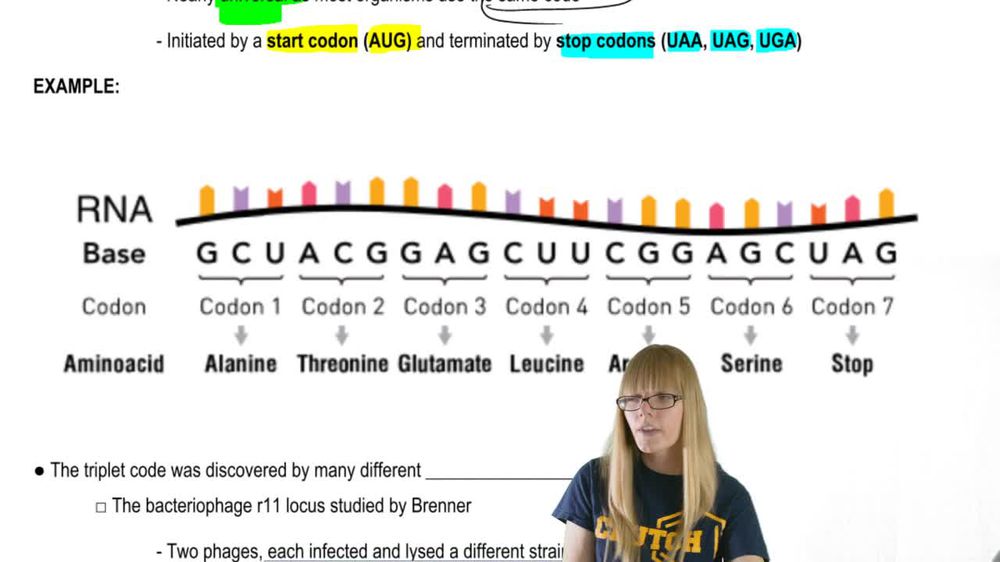
The genetic code is a set of rules that defines how the sequence of nucleotides in mRNA is translated into amino acids, the building blocks of proteins. It consists of codons, which are triplets of nucleotides, each corresponding to a specific amino acid or a stop signal during protein synthesis.
Recommended video:
Guided course
11:43
The Genetic Code

Synthetic mRNA

Synthetic mRNA refers to artificially created strands of messenger RNA that can be designed to contain specific sequences of nucleotides. These synthetic mRNAs are used in experiments to study gene expression, protein synthesis, and the effects of different nucleotide compositions on translation.
Recommended video:
Guided course
08:39
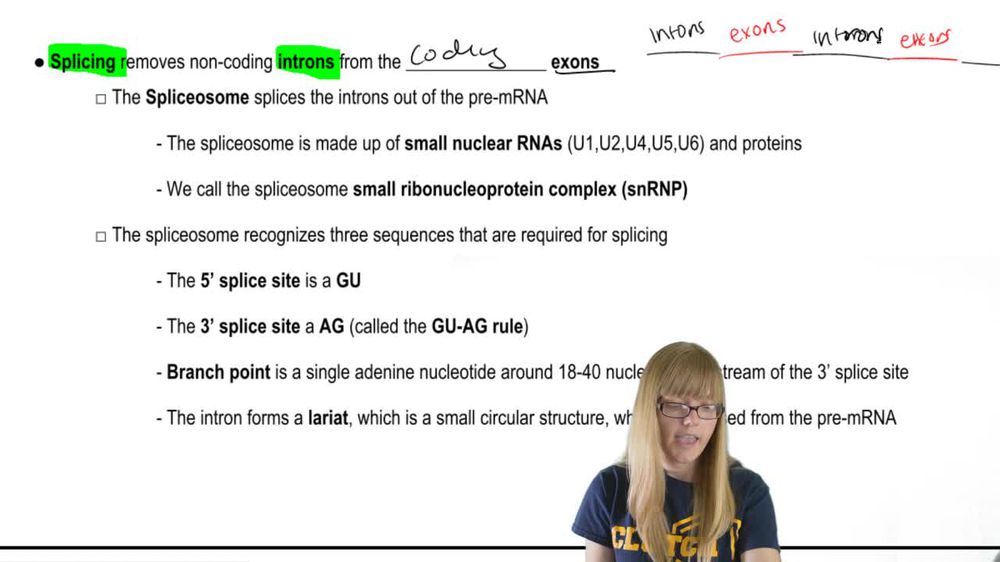
mRNA Processing

Polycytidylic Acid (Poly-C)

Polycytidylic acid, or Poly-C, is a synthetic mRNA composed entirely of cytosine nucleotides. Studies involving Poly-C have shown that it predominantly codes for the amino acid proline during translation, illustrating how the composition of mRNA influences the resulting protein synthesis.
Recommended video:
Guided course
08:39
mRNA Processing