Pearson+ LogoPearson+ Logo
Ch. 9 - The Molecular Biology of Translation
Sanders - Genetic Analysis: An Integrated Approach 3rd Edition
Sanders3rd EditionGenetic Analysis: An Integrated ApproachISBN: 9780135564172Not the one you use?Change textbook
Chapter 9, Problem 2a

In the experiments that deciphered the genetic code, many different synthetic mRNA sequences were tested.
Describe how the codon for phenylalanine was identified.

Verified step by step guidance
1
Understand the context: The genetic code was deciphered using synthetic mRNA sequences in experiments conducted by researchers like Nirenberg and Matthaei. These experiments aimed to determine which codons correspond to specific amino acids.
Recognize the experimental setup: In the case of phenylalanine, a synthetic mRNA sequence composed entirely of uracil nucleotides (poly-U) was synthesized. This sequence would look like UUUUUU... (repeating U bases).
Explain the translation process: The synthetic poly-U mRNA was added to a cell-free system containing ribosomes, tRNAs, and amino acids, where one of the amino acids was radioactively labeled to track its incorporation into a protein.
Describe the observation: When the poly-U mRNA was used, the radioactive phenylalanine was incorporated into the protein, indicating that the codon UUU specifies phenylalanine.
Conclude the finding: This experiment demonstrated that the codon UUU in mRNA corresponds to the amino acid phenylalanine, contributing to the understanding of the genetic code.

Verified video answer for a similar problem:

This video solution was recommended by our tutors as helpful for the problem above.
Video duration:
3m
Was this helpful?

Key Concepts

Here are the essential concepts you must grasp in order to answer the question correctly.

Codons

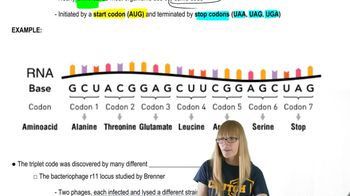
Codons are sequences of three nucleotides in mRNA that correspond to specific amino acids or stop signals during protein synthesis. Each codon is crucial for translating the genetic information encoded in DNA into functional proteins. Understanding codons is essential for deciphering how genetic information is expressed and how specific amino acids, like phenylalanine, are incorporated into proteins.
Recommended video:
Guided course
11:43
The Genetic Code

Synthetic mRNA

Synthetic mRNA refers to artificially created messenger RNA sequences used in experiments to study the genetic code. By introducing these synthetic mRNAs into a system, researchers can observe which amino acids are produced, allowing them to determine the relationship between specific codons and their corresponding amino acids. This method was pivotal in identifying the codon for phenylalanine.
Recommended video:
Guided course
08:39
mRNA Processing

Amino Acid Translation

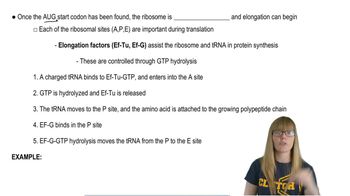
Amino acid translation is the process by which the sequence of codons in mRNA is translated into a sequence of amino acids, forming a protein. This process occurs during translation, where ribosomes read the mRNA and tRNA molecules bring the appropriate amino acids. Identifying the codon for phenylalanine involved determining which specific codon sequence led to the incorporation of phenylalanine into the growing polypeptide chain.
Recommended video:
Guided course
04:01
Translation Elongation
Related Practice
Textbook Question

If you were to look up Gaucher disease on the OMIM website, you would see that there are three major types, designated Type I (OMIM 230800), Type II (OMIM 230900), and Type III (OMIM 231000). All three types are mutations of the gene for acid-β-glucosidase, encoded on chromosome 1. Different mutations of this gene produce the three types of Gaucher disease that differ somewhat in their symptoms and disease severity.

Thinking about the production or function of the acid-β-glucosidase enzyme, why do you suppose different mutations of this gene produce differences in symptoms and disease severity?

628
views
Textbook Question

Some proteins are composed of two or more polypeptides. Suppose the DNA template strand sequence 3′-TACGTAGGCTAACGGAGTAAGCTAACT-5′ produces a polypeptide that joins in pairs to form a functional protein. What is the amino acid sequence of the polypeptide produced from this sequence?

603
views
Textbook Question

Some proteins are composed of two or more polypeptides. Suppose the DNA template strand sequence 3′-TACGTAGGCTAACGGAGTAAGCTAACT-5′ produces a polypeptide that joins in pairs to form a functional protein.

What term is used to identify a functional protein like this one formed when two identical polypeptides join together?

636
views
Textbook Question

In the experiments that deciphered the genetic code, many different synthetic mRNA sequences were tested.

What was the result of studies of synthetic mRNAs composed exclusively of cytosine?

697
views
Textbook Question

In the experiments that deciphered the genetic code, many different synthetic mRNA sequences were tested.

What result was obtained for synthetic mRNAs containing AG repeats, that is, AGAGAGAG...?

572
views
Textbook Question

In the experiments that deciphered the genetic code, many different synthetic mRNA sequences were tested.

Predict the results of experiments examining GCUA repeats.

604
views