Pearson+ LogoPearson+ Logo
Ch. 11 - DNA Replication and Recombination
Klug - Concepts of Genetics  12th Edition
Klug12th EditionConcepts of Genetics ISBN: 9780135564776Not the one you use?Change textbook
Chapter 11, Problem 1e

In the discussion, we focused on how DNA is replicated and synthesized. We also discussed recombination at the DNA level. Along the way, we encountered many opportunities to consider how this information was acquired. On the basis of these discussions, what answers would you propose to the following fundamental questions?
What observations reveal that a 'telomere problem' exists during eukaryotic DNA replication, and how did we learn of the solution to this problem?

Verified step by step guidance
1
Step 1: Understand the 'telomere problem' by recognizing that during eukaryotic DNA replication, the ends of linear chromosomes (telomeres) cannot be fully replicated by DNA polymerase because it requires a primer and synthesizes DNA only in the 5' to 3' direction. This leads to progressive shortening of chromosomes with each cell division.
Step 2: Identify the key observations that revealed this problem, such as experiments showing that chromosome ends shorten after repeated rounds of DNA replication in somatic cells, and that this shortening correlates with cellular aging or senescence.
Step 3: Review how scientists discovered the solution by studying specialized structures at chromosome ends called telomeres, which consist of repetitive DNA sequences that protect coding regions from loss.
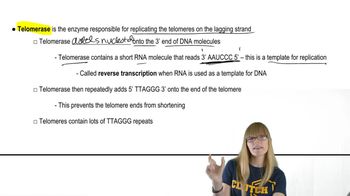
Step 4: Explore the discovery of the enzyme telomerase, which extends telomeres by adding repetitive sequences to the 3' end of chromosomes, thus compensating for the shortening that occurs during replication. This was learned through experiments in organisms like Tetrahymena and yeast, where telomerase activity was detected and linked to telomere maintenance.
Step 5: Summarize that the combination of molecular biology techniques, such as labeling newly synthesized DNA, genetic studies of mutants lacking telomerase, and biochemical assays, helped elucidate both the existence of the telomere problem and the mechanism by which telomerase solves it.

Verified video answer for a similar problem:

This video solution was recommended by our tutors as helpful for the problem above.
Video duration:
2m
Was this helpful?

Key Concepts

Here are the essential concepts you must grasp in order to answer the question correctly.

Telomere Structure and Function

Telomeres are repetitive DNA sequences at the ends of eukaryotic chromosomes that protect them from degradation and prevent chromosome fusion. They act as protective caps, ensuring genome stability during cell division. Understanding their structure is essential to grasp why their replication poses a unique challenge.
Recommended video:
Guided course
08:38
Telomeres and Telomerase

The End-Replication Problem

During DNA replication, the lagging strand cannot be fully copied at the chromosome ends, leading to progressive shortening of telomeres with each cell division. This 'end-replication problem' was identified through observations of incomplete replication and chromosome shortening in eukaryotic cells.
Recommended video:
Guided course
14:31
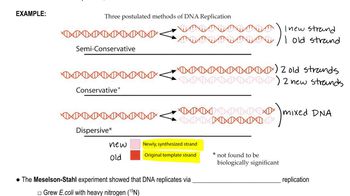
Semiconservative Replication

Telomerase and Its Discovery

Telomerase is a ribonucleoprotein enzyme that extends telomeres by adding repetitive sequences, solving the end-replication problem. Its discovery involved biochemical assays and genetic studies in organisms like Tetrahymena, revealing how cells maintain chromosome length and genomic integrity.
Recommended video:
Guided course
08:38
Telomeres and Telomerase
Related Practice
Textbook Question

In the discussion, we focused on how DNA is replicated and synthesized. We also discussed recombination at the DNA level. Along the way, we encountered many opportunities to consider how this information was acquired. On the basis of these discussions, what answers would you propose to the following fundamental questions?

How was it demonstrated that DNA synthesis occurs under the direction of DNA polymerase III and not polymerase I?

629
views
Textbook Question

In the discussion, we focused on how DNA is replicated and synthesized. We also discussed recombination at the DNA level. Along the way, we encountered many opportunities to consider how this information was acquired. On the basis of these discussions, what answers would you propose to the following fundamental questions?

How do we know that in vivo DNA synthesis occurs in the 5' to 3' direction?

659
views
Textbook Question

In the discussion, we focused on how DNA is replicated and synthesized. We also discussed recombination at the DNA level. Along the way, we encountered many opportunities to consider how this information was acquired. On the basis of these discussions, what answers would you propose to the following fundamental questions?

How do we know that DNA synthesis is discontinuous on one of the two template strands?

526
views
Textbook Question

Write a short essay that distinguishes between the terms replication and synthesis, as applied to DNA. Which of the two is most closely allied with the field of biochemistry?

715
views
Textbook Question

Compare conservative, semiconservative, and dispersive modes of DNA replication.

1298
views
Textbook Question

Describe the role of ¹⁵N in the Meselson–Stahl experiment.

917
views