Pearson+ LogoPearson+ Logo
Ch. 4 - Extensions of Mendelian Genetics
Klug - Concepts of Genetics  12th Edition
Klug12th EditionConcepts of Genetics ISBN: 9780135564776Not the one you use?Change textbook
Chapter 4, Problem 39b

A geneticist from an alien planet that prohibits genetic research brought with him to Earth two pure-breeding lines of frogs. One line croaks by uttering 'rib-it rib-it' and has purple eyes. The other line croaks more softly by muttering 'knee-deep knee-deep' and has green eyes. With a newfound freedom of inquiry, the geneticist mated the two types of frogs, producing F₁ frogs that were all utterers and had blue eyes. A large F₂ generation then yielded the following ratios:
27/64 blue-eyed, 'rib-it' utterer
12/64 green-eyed, 'rib-it' utterer
9/64 blue-eyed, 'knee-deep' mutterer
9/64 purple-eyed, 'rib-it' utterer
4/64 green-eyed, 'knee-deep' mutterer
3/64 purple-eyed, 'knee-deep' mutterer
Of these, how many are controlling eye color? How can you tell? How many are controlling croaking?

Verified step by step guidance
1
Step 1: Identify the traits and their phenotypes. We have two traits: croaking sound ('rib-it' vs. 'knee-deep') and eye color (purple, blue, green). The parental lines are pure-breeding for these traits, so each parent is homozygous for its respective alleles.
Step 2: Analyze the F₁ generation phenotype. All F₁ frogs are 'rib-it' utterers with blue eyes, indicating that 'rib-it' and blue eyes are dominant phenotypes or result from heterozygous combinations.
Step 3: Examine the F₂ phenotypic ratios and total number of phenotypic classes. There are 6 phenotypic classes with specific fractions out of 64, suggesting a dihybrid cross involving two genes, each with multiple alleles or interactions.
Step 4: Determine the number of genes controlling each trait by comparing the observed ratios to expected Mendelian ratios. For example, a 27/64 ratio corresponds to (3/4)^3, which suggests three genes controlling eye color (since 64 = 4^3), while croaking phenotypes fit a simpler ratio, indicating fewer genes.
Step 5: Conclude that eye color is controlled by three genes (polygenic inheritance) because the phenotypic ratios fit a 3-gene model, while croaking is controlled by one gene (monogenic) because the ratios fit a simpler dominant/recessive pattern.

Verified video answer for a similar problem:

This video solution was recommended by our tutors as helpful for the problem above.
Video duration:
6m
Was this helpful?

Key Concepts

Here are the essential concepts you must grasp in order to answer the question correctly.

Dihybrid Cross and Mendelian Ratios

A dihybrid cross involves two genes, each with two alleles, and their independent assortment during gamete formation. The classic Mendelian ratio for two independently assorting genes with complete dominance is 9:3:3:1 in the F2 generation. Deviations or expansions of this ratio can indicate more complex inheritance patterns or multiple alleles.
Recommended video:
Guided course
06:28
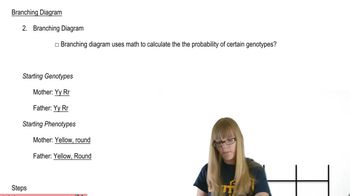
Branch Diagram

Gene Interaction and Phenotypic Ratios

Phenotypic ratios in offspring reveal how many genes control traits and their interaction. When multiple genes influence traits independently, expected ratios follow Mendelian patterns. Complex ratios suggest multiple genes or linked genes, and analyzing the distribution of phenotypes helps determine the number of genes involved.
Recommended video:
Guided course
07:56
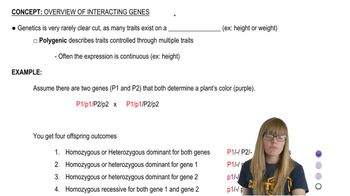
Interacting Genes Overview

Determining Number of Genes from Phenotypic Classes

The number of phenotypic classes in the F2 generation can indicate how many genes control a trait. For example, 4 phenotypic classes suggest two genes (2^2=4), while 8 classes suggest three genes (2^3=8). By counting distinct phenotype combinations and their ratios, one can infer the number of genes controlling each trait.
Recommended video:
Guided course
09:09
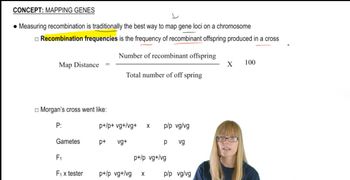
Mapping Genes
Related Practice
Textbook Question

A true-breeding purple-leafed plant isolated from one side of El Yunque, the rain forest in Puerto Rico, was crossed to a true-breeding white variety found on the other side. The F₁ offspring were all purple. A large number of F₁ x F₁ crosses produced the following results:

purple: 4219, white: 5781 (Total = 10,000)

Propose an explanation for the inheritance of leaf color. As a geneticist, how might you go about testing your hypothesis? Describe the genetic experiments that you would conduct.

575
views
Textbook Question

In Dexter and Kerry cattle, animals may be polled (hornless) or horned. The Dexter animals have short legs, whereas the Kerry animals have long legs. When many offspring were obtained from matings between polled Kerrys and horned Dexters, half were found to be polled Dexters and half polled Kerrys. When these two types of F₁ cattle were mated to one another, the following F₂ data were obtained:

3/8 polled Dexters

3/8 polled Kerrys

1/8 horned Dexters

1/8 horned Kerrys

A geneticist was puzzled by these data and interviewed farmers who had bred these cattle for decades. She learned that Kerrys were true breeding. Dexters, on the other hand, were not true breeding and never produced as many offspring as Kerrys. Provide a genetic explanation for these observations.

727
views
Textbook Question

A geneticist from an alien planet that prohibits genetic research brought with him to Earth two pure-breeding lines of frogs. One line croaks by uttering 'rib-it rib-it' and has purple eyes. The other line croaks more softly by muttering 'knee-deep knee-deep' and has green eyes. With a newfound freedom of inquiry, the geneticist mated the two types of frogs, producing F₁ frogs that were all utterers and had blue eyes. A large F₂ generation then yielded the following ratios:

27/64 blue-eyed, 'rib-it' utterer

12/64 green-eyed, 'rib-it' utterer

9/64 blue-eyed, 'knee-deep' mutterer

9/64 purple-eyed, 'rib-it' utterer

4/64 green-eyed, 'knee-deep' mutterer

3/64 purple-eyed, 'knee-deep' mutterer

How many total gene pairs are involved in the inheritance of both traits? Support your answer.

490
views
Textbook Question

A geneticist from an alien planet that prohibits genetic research brought with him to Earth two pure-breeding lines of frogs. One line croaks by uttering 'rib-it rib-it' and has purple eyes. The other line croaks more softly by muttering 'knee-deep knee-deep' and has green eyes. With a newfound freedom of inquiry, the geneticist mated the two types of frogs, producing F₁ frogs that were all utterers and had blue eyes. A large F₂ generation then yielded the following ratios:

27/64 blue-eyed, 'rib-it' utterer

12/64 green-eyed, 'rib-it' utterer

9/64 blue-eyed, 'knee-deep' mutterer

9/64 purple-eyed, 'rib-it' utterer

4/64 green-eyed, 'knee-deep' mutterer

3/64 purple-eyed, 'knee-deep' mutterer

Assign gene symbols for all phenotypes and indicate the genotypes of the P₁ and F₁ frogs.

508
views
Textbook Question

A geneticist from an alien planet that prohibits genetic research brought with him to Earth two pure-breeding lines of frogs. One line croaks by uttering 'rib-it rib-it' and has purple eyes. The other line croaks more softly by muttering 'knee-deep knee-deep' and has green eyes. With a newfound freedom of inquiry, the geneticist mated the two types of frogs, producing F₁ frogs that were all utterers and had blue eyes. A large F₂ generation then yielded the following ratios:

27/64 blue-eyed, 'rib-it' utterer

12/64 green-eyed, 'rib-it' utterer

9/64 blue-eyed, 'knee-deep' mutterer

9/64 purple-eyed, 'rib-it' utterer

4/64 green-eyed, 'knee-deep' mutterer

3/64 purple-eyed, 'knee-deep' mutterer

Indicate the genotypes of the six F₂ phenotypes.

460
views
Textbook Question

A geneticist from an alien planet that prohibits genetic research brought with him to Earth two pure-breeding lines of frogs. One line croaks by uttering 'rib-it rib-it' and has purple eyes. The other line croaks more softly by muttering 'knee-deep knee-deep' and has green eyes. With a newfound freedom of inquiry, the geneticist mated the two types of frogs, producing F₁ frogs that were all utterers and had blue eyes. A large F₂ generation then yielded the following ratios:

27/64 blue-eyed, 'rib-it' utterer

12/64 green-eyed, 'rib-it' utterer

9/64 blue-eyed, 'knee-deep' mutterer

9/64 purple-eyed, 'rib-it' utterer

4/64 green-eyed, 'knee-deep' mutterer

3/64 purple-eyed, 'knee-deep' mutterer

After years of experiments, the geneticist isolated pure-breeding strains of all six F₂ phenotypes. Indicate the F₁ and F₂ phenotypic ratios of the following cross using these pure-breeding strains: blue-eyed, 'knee-deep' mutterer x purpled-eyed, 'rib-it' utterer.

426
views