Pearson+ LogoPearson+ Logo
Ch. 4 - Extensions of Mendelian Genetics
Klug - Concepts of Genetics  12th Edition
Klug12th EditionConcepts of Genetics ISBN: 9780135564776Not the one you use?Change textbook
Chapter 4, Problem 27

In Drosophila, the X-linked recessive mutation vermilion (v) causes bright red eyes, in contrast to the brick-red eyes of wild type. A separate autosomal recessive mutation, suppressor of vermilion (su-v), causes flies homozygous or hemizygous for v to have wild-type eyes. In the absence of vermilion alleles, su-v has no effect on eye color. Determine the F₁ and F₂ phenotypic ratios from a cross between a female with wild-type alleles at the vermilion locus, but who is homozygous for su-v, with a vermilion male who has wild-type alleles at the su-v locus.

Verified step by step guidance
1
Step 1: Define the genotypes of the parents. The female is wild-type for vermilion (X^+X^+) but homozygous recessive for the suppressor (su-v/su-v). The male is vermilion mutant (X^vY) but wild-type for the suppressor (Su-v+/Su-v+).
Step 2: Determine the possible gametes from each parent. The female can produce X^+ chromosomes with su-v alleles, while the male can produce X^v or Y chromosomes with Su-v+ alleles.
Step 3: Construct the F₁ genotypes by combining the gametes. For females, combine X^+ (su-v) from the mother with X^v (Su-v+) from the father. For males, combine X^+ (su-v) from the mother with Y (Su-v+) from the father.
Step 4: Analyze the F₁ phenotypes based on the genotypes. Remember that vermilion is X-linked recessive, and su-v suppresses vermilion only when homozygous or hemizygous with vermilion. Determine which flies show wild-type or vermilion eye color.
Step 5: For the F₂ generation, consider a cross between F₁ individuals. Determine all possible allele combinations for both loci, and then predict the phenotypic ratios by applying the inheritance patterns of X-linked vermilion and autosomal suppressor su-v, including the suppression effect.

Verified video answer for a similar problem:

This video solution was recommended by our tutors as helpful for the problem above.
Video duration:
3m
Was this helpful?

Key Concepts

Here are the essential concepts you must grasp in order to answer the question correctly.

X-linked Recessive Inheritance

X-linked recessive traits are controlled by genes on the X chromosome. Males, having only one X chromosome, express the trait if they inherit the mutant allele, while females require two copies. This pattern affects phenotypic ratios differently in males and females, important for predicting offspring outcomes in crosses involving X-linked genes.
Recommended video:
Guided course
09:30
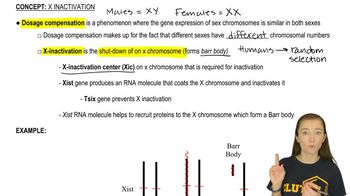
X-Inactivation

Autosomal Recessive Suppressor Mutation

A suppressor mutation is a secondary mutation that counteracts the effect of a primary mutation. When autosomal and recessive, it requires two copies to show its effect. In this case, the suppressor (su-v) masks the vermilion phenotype only when vermilion alleles are present, illustrating gene interaction and epistasis.
Recommended video:
Guided course
04:46
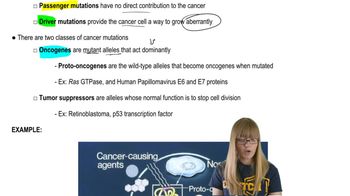
Cancer Mutations

Genetic Crosses and Phenotypic Ratios

Analyzing genetic crosses involves determining genotypes of parents, predicting gametes, and combining them to find offspring genotypes and phenotypes. Understanding how linked and unlinked genes segregate and interact allows calculation of expected phenotypic ratios in F₁ and F₂ generations, essential for solving this problem.
Recommended video:
Guided course
10:20
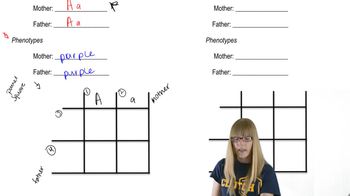
Monohybrid Cross
Related Practice
Textbook Question

In humans, the ABO blood type is under the control of autosomal multiple alleles. Color blindness is a recessive X-linked trait. If two parents who are both type A and have normal vision produce a son who is color-blind and is type O, what is the probability that their next child will be a female who has normal vision and is type O?

1181
views
Textbook Question

In Drosophila, an X-linked recessive mutation, scalloped (sd), causes irregular wing margins. Diagram the F₁ and F₂ results if (a) a scalloped female is crossed with a normal male; (b) a scalloped male is crossed with a normal female. Compare these results with those that would be obtained if the scalloped gene were autosomal.

1656
views
Textbook Question

Another recessive mutation in Drosophila, ebony (e), is on an autosome (chromosome 3) and causes darkening of the body compared with wild-type flies. What phenotypic F₁ and F₂ male and female ratios will result if a scalloped-winged female with normal body color is crossed with a normal-winged ebony male?

Work out this problem by both the Punnett square method and the forked-line method.

884
views
Textbook Question

While vermilion is X-linked in Drosophila and causes the eye color to be bright red, brown is an autosomal recessive mutation that causes the eye to be brown. Flies carrying both mutations lose all pigmentation and are white-eyed. Predict the F₁ and F₂ results of the following crosses:

vermilion females x brown males

470
views
Textbook Question

While vermilion is X-linked in Drosophila and causes the eye color to be bright red, brown is an autosomal recessive mutation that causes the eye to be brown. Flies carrying both mutations lose all pigmentation and are white-eyed. Predict the F₁ and F₂ results of the following crosses:

brown females x vermilion males

1639
views
Textbook Question

While vermilion is X-linked in Drosophila and causes the eye color to be bright red, brown is an autosomal recessive mutation that causes the eye to be brown. Flies carrying both mutations lose all pigmentation and are white-eyed. Predict the F₁ and F₂ results of the following crosses:

white females x wild-type males

1884
views