Pearson+ LogoPearson+ Logo
Ch. 5 - Chromosome Mapping in Eukaryotes
Klug - Concepts of Genetics  12th Edition
Klug12th EditionConcepts of Genetics ISBN: 9780135564776Not the one you use?Change textbook
Chapter 5, Problem 12b

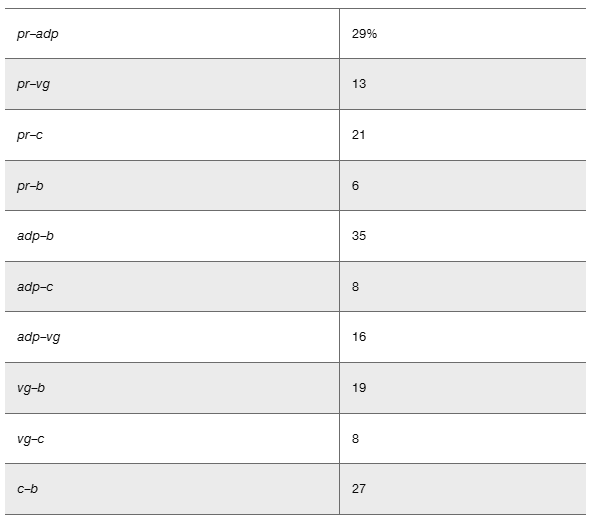
In a series of two-point mapping crosses involving five genes located on chromosome II in Drosophila, the following recombinant (single-crossover) frequencies were observed:
Table showing recombinant frequencies (%) between gene pairs pr-adp 29, pr-vg 13, pr-c 21, pr-b 6, adp-b 35, adp-c 8, adp-vg 16, vg-b 19, vg-c 8, and c-b 27.
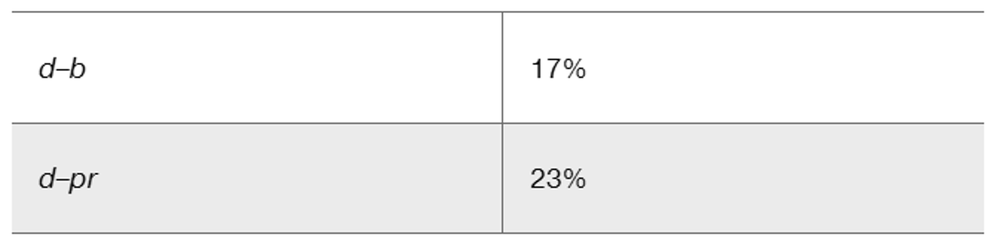
In another set of experiments, a sixth gene, d, was tested against b and pr:
Table showing recombinant frequencies: d-b is 17% and d-pr is 23% in two-point gene mapping crosses.
Predict the results of two-point mapping between d and c, d and vg, and d and adp.

Verified step by step guidance
1
Step 1: Construct the gene map for the five known genes (pr, adp, vg, c, b) using the given recombinant frequencies. Use the smallest distances to order the genes, remembering that the recombination frequency (%) approximates the map distance in centiMorgans (cM). For example, start with pr and b since pr-b is 6%, then place other genes relative to these based on their distances.
Step 2: Using the gene order and distances, calculate the approximate map positions of each gene on chromosome II. This involves adding or subtracting the recombination frequencies between adjacent genes to find their relative positions on the chromosome.
Step 3: Incorporate the sixth gene d into the existing map by using the given recombination frequencies d-b = 17% and d-pr = 23%. Determine the possible positions of d relative to pr and b by comparing these distances to the existing map positions of pr and b.
Step 4: Once the position of d is estimated, calculate the expected recombination frequencies between d and the other genes c, vg, and adp by finding the map distance between d and each of these genes on the chromosome. Use the formula: \(\text{Recombination frequency} \approx \text{map distance (cM)}\).
Step 5: Predict the two-point recombination frequencies for d-c, d-vg, and d-adp by measuring the distances between d and each gene on the map and expressing these distances as percentages, which correspond to the expected recombinant frequencies.

Verified video answer for a similar problem:

This video solution was recommended by our tutors as helpful for the problem above.
Video duration:
3m
Was this helpful?

Key Concepts

Here are the essential concepts you must grasp in order to answer the question correctly.

Two-Point Mapping and Recombination Frequency

Two-point mapping measures the recombination frequency between two genes to estimate their physical distance on a chromosome. The recombination frequency, expressed as a percentage, reflects how often crossing over occurs between the genes during meiosis. Lower percentages indicate closer proximity, while higher percentages suggest greater distance.
Recommended video:
Guided course
09:09
Mapping Genes

Additivity of Map Distances and Gene Order

Map distances between genes on a chromosome are additive when genes are arranged linearly. By knowing recombination frequencies between pairs of genes, one can deduce gene order and predict distances between genes not directly tested by summing or subtracting known distances. This principle helps in predicting unknown recombination frequencies.
Recommended video:
Guided course
09:09
Mapping Genes

Limitations of Recombination Frequency and Interference

Recombination frequencies above 50% do not accurately reflect physical distances due to multiple crossovers. Additionally, crossover interference can affect the expected frequency of double crossovers, complicating distance predictions. Understanding these limitations is essential when interpreting mapping data and making predictions.
Recommended video:
Guided course
06:59
RNA Interference
Related Practice
Textbook Question

Colored aleurone in the kernels of corn is due to the dominant allele R. The recessive allele r, when homozygous, produces colorless aleurone. The plant color (not the kernel color) is controlled by another gene with two alleles, Y and y. The dominant Y allele results in green color, whereas the homozygous presence of the recessive y allele causes the plant to appear yellow. In a testcross between a plant of unknown genotype and phenotype and a plant that is homozygous recessive for both traits, the following progeny were obtained:

colored, green: 88

colored, yellow: 12

colorless, green: 8

colorless, yellow: 92

Explain how these results were obtained by determining the exact genotype and phenotype of the unknown plant, including the precise arrangement of the alleles on the homologs.

1306
views
Textbook Question

In the cross shown here, involving two linked genes, ebony (e) and claret (ca), in Drosophila, where crossing over does not occur in males, offspring were produced in a 2 + : 1 ca : 1 e phenotypic ratio:

These genes are 30 units apart on chromosome III. What did crossing over in the female contribute to these phenotypes?

1054
views
Textbook Question

In a series of two-point mapping crosses involving five genes located on chromosome II in Drosophila, the following recombinant (single-crossover) frequencies were observed:

Given that the adp gene is near the end of chromosome II (locus 83), construct a map of these genes.

1407
views
Textbook Question

Two different female Drosophila were isolated, each heterozygous for the autosomally linked genes b (black body), d (dachs tarsus), and c (curved wings). These genes are in the order d–b–c, with b being closer to d than to c. Shown here is the genotypic arrangement for each female along with the various gametes formed by both:

Identify which categories are noncrossovers (NCOs), single crossovers (SCOs), and double crossovers (DCOs) in each case. Then, indicate the relative frequency in which each will be produced.

906
views
Textbook Question

In Drosophila, a cross was made between females—all expressing the three X-linked recessive traits scute bristles (sc), sable body (s), and vermilion eyes (v)—and wild-type males. In the F1, all females were wild type, while all males expressed all three mutant traits. The cross was carried to the F2 generation, and 1000 offspring were counted, with the results shown in the following table.

No determination of sex was made in the data.

Using proper nomenclature, determine the genotypes of the P1 and F1 parents.

2076
views
Textbook Question

In Drosophila, a cross was made between females—all expressing the three X-linked recessive traits scute bristles (sc), sable body (s), and vermilion eyes (v)—and wild-type males. In the F1, all females were wild type, while all males expressed all three mutant traits. The cross was carried to the F2 generation, and 1000 offspring were counted, with the results shown in the following table.

No determination of sex was made in the data.

Determine the sequence of the three genes and the map distances between them.

776
views