Pearson+ LogoPearson+ Logo
Ch. 10 - Eukaryotic Chromosome Abnormalities and Molecular Organization
Sanders - Genetic Analysis: An Integrated Approach 3rd Edition
Sanders3rd EditionGenetic Analysis: An Integrated ApproachISBN: 9780135564172Not the one you use?Change textbook
Chapter 10, Problem 14d

Dr. Ara B. Dopsis has an idea he thinks will be a boon to agriculture. He wants to create the 'pomato,' a hybrid between a tomato (Lycopersicon esculentum) that has 12 chromosomes and a potato (Solanum tuberosum) that has 48 chromosomes. Dr. Dopsis is hoping his new pomato will have tuber growth like a potato and the fruit production of a tomato. He joins a haploid gamete from each species to form a hybrid and then induces doubling of chromosome number.
Can Dr. Dopsis be sure the polyploid will have the characteristics he wants? Why or why not?

Verified step by step guidance
1
Understand the chromosome numbers of the two species involved: The tomato (Lycopersicon esculentum) has 12 chromosomes (2n = 24, meaning its haploid gamete has n = 12), and the potato (Solanum tuberosum) has 48 chromosomes (2n = 48, meaning its haploid gamete has n = 24).
Determine the chromosome number of the hybrid: When a haploid gamete from the tomato (n = 12) combines with a haploid gamete from the potato (n = 24), the resulting hybrid will have 12 + 24 = 36 chromosomes.
Consider the induced doubling of chromosome number: Dr. Dopsis plans to double the chromosome number of the hybrid, which would result in 36 × 2 = 72 chromosomes. This doubling creates a polyploid organism.
Evaluate the compatibility of the genomes: The hybrid organism will contain genetic material from both species, but the chromosomes from the tomato and potato may not pair properly during meiosis due to differences in their structure and genetic content. This can lead to sterility or unpredictable traits.
Assess the likelihood of desired traits: While the polyploid may exhibit some characteristics of both parent species, such as tuber growth and fruit production, the expression of these traits depends on complex interactions between the genes from both species. There is no guarantee that the polyploid will exhibit the desired combination of traits in a stable and predictable manner.

Verified video answer for a similar problem:

This video solution was recommended by our tutors as helpful for the problem above.
Video duration:
1m
Was this helpful?

Key Concepts

Here are the essential concepts you must grasp in order to answer the question correctly.

Hybridization

Hybridization is the process of crossing two different species or varieties to produce a hybrid offspring. In the case of Dr. Dopsis, he is attempting to hybridize a tomato and a potato to create the 'pomato.' This process can lead to new traits, but the success of achieving desired characteristics depends on genetic compatibility and the expression of traits from both parent species.
Recommended video:
Guided course
03:08
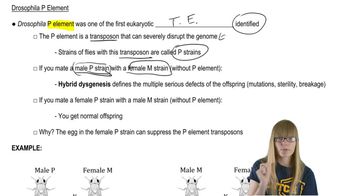
Drosophila P Element

Polyploidy

Polyploidy refers to the condition of having more than two complete sets of chromosomes. In Dr. Dopsis's experiment, he induces chromosome doubling after hybridization, which can stabilize the hybrid and potentially enhance certain traits. However, the effects of polyploidy on phenotype can be unpredictable, as it may lead to gene dosage effects and altered gene expression.
Recommended video:
Guided course
04:03
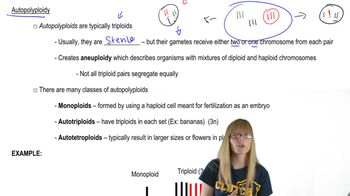
Autopolyploidy

Gene Expression and Trait Inheritance

Gene expression is the process by which information from a gene is used to synthesize functional gene products, typically proteins, which influence an organism's traits. The inheritance of traits in hybrids like the pomato can be complex, as dominant and recessive alleles from both parent species may interact in unforeseen ways, making it uncertain whether the desired characteristics will manifest in the polyploid offspring.
Recommended video:
Guided course
13:40
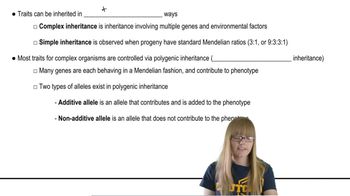
Traits and Variance
Related Practice
Textbook Question

Dr. Ara B. Dopsis has an idea he thinks will be a boon to agriculture. He wants to create the 'pomato,' a hybrid between a tomato (Lycopersicon esculentum) that has 12 chromosomes and a potato (Solanum tuberosum) that has 48 chromosomes. Dr. Dopsis is hoping his new pomato will have tuber growth like a potato and the fruit production of a tomato. He joins a haploid gamete from each species to form a hybrid and then induces doubling of chromosome number. How many chromosomes will the hybrid have before chromosome doubling?

425
views
Textbook Question

Dr. Ara B. Dopsis has an idea he thinks will be a boon to agriculture. He wants to create the 'pomato,' a hybrid between a tomato (Lycopersicon esculentum) that has 12 chromosomes and a potato (Solanum tuberosum) that has 48 chromosomes. Dr. Dopsis is hoping his new pomato will have tuber growth like a potato and the fruit production of a tomato. He joins a haploid gamete from each species to form a hybrid and then induces doubling of chromosome number. Will this hybrid be infertile?

379
views
Textbook Question

Dr. Ara B. Dopsis has an idea he thinks will be a boon to agriculture. He wants to create the 'pomato,' a hybrid between a tomato (Lycopersicon esculentum) that has 12 chromosomes and a potato (Solanum tuberosum) that has 48 chromosomes. Dr. Dopsis is hoping his new pomato will have tuber growth like a potato and the fruit production of a tomato. He joins a haploid gamete from each species to form a hybrid and then induces doubling of chromosome number.

How many chromosomes will the polyploid have after chromosome doubling?

468
views
Textbook Question

A normal chromosome and its homolog carrying a paracentric inversion are shown here. The dot (·) represents the centromere.

Normal    ABC • DEFGHIJK

Inversion  abc • djihgfe

Diagram the alignment of chromosomes during prophase I.

455
views
Textbook Question

A normal chromosome and its homolog carrying a paracentric inversion are shown here. The dot (·) represents the centromere.

Normal    ABC • DEFGHIJK

Inversion  abc • djihgfe

Assume a crossover takes place in the region between F and G. Identify the gametes that are formed following this crossover, and indicate which, if any, gametes are viable.

720
views
Textbook Question

A normal chromosome and its homolog carrying a paracentric inversion are shown here. The dot (·) represents the centromere.

Normal    ABC • DEFGHIJK

Inversion  abc • djihgfe

Assume a crossover takes place in the region between A and B. Identify the gametes that are formed by this crossover event, and indicate which, if any, gametes are viable.

462
views