Pearson+ LogoPearson+ Logo
Ch. 10 - Eukaryotic Chromosome Abnormalities and Molecular Organization
Sanders - Genetic Analysis: An Integrated Approach 3rd Edition
Sanders3rd EditionGenetic Analysis: An Integrated ApproachISBN: 9780135564172Not the one you use?Change textbook
Chapter 10, Problem 3b

In eukaryotic DNA, where are you most likely to find histone protein H1?

Verified step by step guidance
1
Understand the role of histone proteins in eukaryotic DNA. Histones are proteins that help package and organize DNA into chromatin, allowing it to fit within the nucleus.
Learn about the specific types of histones. There are core histones (H2A, H2B, H3, and H4) that form the nucleosome, and histone H1, which is known as the linker histone.
Recognize the function of histone H1. Histone H1 binds to the DNA between nucleosomes, stabilizing the structure of the chromatin and helping to compact it further.
Identify the location of histone H1 in eukaryotic DNA. Histone H1 is most likely found in the linker regions of DNA, which are the stretches of DNA between nucleosomes.
Conclude that histone H1 plays a critical role in higher-order chromatin structure and is essential for the regulation of gene expression and DNA accessibility.

Verified video answer for a similar problem:

This video solution was recommended by our tutors as helpful for the problem above.
Video duration:
2m
Was this helpful?

Key Concepts

Here are the essential concepts you must grasp in order to answer the question correctly.

Histone Proteins

Histone proteins are essential components of chromatin in eukaryotic cells. They help package DNA into a compact, organized structure, allowing for efficient storage and regulation of genetic material. Histones can undergo various modifications that influence gene expression and DNA accessibility.
Recommended video:

Chromatin Structure

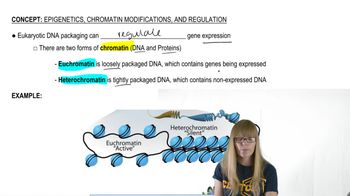
Chromatin is the complex of DNA and proteins found in the nucleus of eukaryotic cells. It exists in two forms: euchromatin, which is loosely packed and accessible for transcription, and heterochromatin, which is tightly packed and generally inactive. The presence of histone H1 is associated with the stabilization of higher-order chromatin structures.
Recommended video:

Nucleosome

A nucleosome is the fundamental unit of chromatin, consisting of a segment of DNA wrapped around a core of histone proteins. Histone H1 binds to the linker DNA between nucleosomes, facilitating the compaction of chromatin into higher-order structures. This organization is crucial for DNA protection and regulation during processes like replication and transcription.
Recommended video: