Pearson+ LogoPearson+ Logo
Ch. 11 - Gene Mutation, DNA Repair, and Homologous Recombination
Sanders - Genetic Analysis: An Integrated Approach 3rd Edition
Sanders3rd EditionGenetic Analysis: An Integrated ApproachISBN: 9780135564172Not the one you use?Change textbook
Chapter 11, Problem 36a

A geneticist searching for mutations uses the restriction endonucleases SmaI and PvuII to search for mutations that eliminate restriction sites. SmaI will not cleave DNA with CpG methylation. It cleaves DNA at the restriction digestion sequence ↓ 5′−CCC GGG−3′ 3′−GGG CCC−3′ ↑ PvuII is not sensitive to CpG methylation. It cleaves DNA at the restriction sequence ↓ 5′−CAG CTG−3′ 3′−GTC GAC−5′ ↑ What common feature do SmaI and PvuII share that would be useful to a researcher searching for mutations that disrupt restriction digestion?

Verified step by step guidance
1
Step 1: Understand the concept of restriction endonucleases. These are enzymes that recognize specific DNA sequences and cleave the DNA at or near these sites. They are widely used in molecular biology for DNA analysis and manipulation.
Step 2: Note the specific recognition sequences for SmaI and PvuII. SmaI recognizes and cleaves the sequence 5′−CCC GGG−3′, while PvuII recognizes and cleaves the sequence 5′−CAG CTG−3′. Both enzymes target palindromic sequences, which are sequences that read the same forward and backward on complementary strands.
Step 3: Consider the role of CpG methylation. SmaI is sensitive to CpG methylation, meaning it will not cleave DNA if the CpG sites within its recognition sequence are methylated. PvuII, on the other hand, is not affected by CpG methylation and will cleave its recognition sequence regardless of methylation status.
Step 4: Reflect on the utility of palindromic recognition sequences. Both SmaI and PvuII recognize palindromic sequences, which are symmetrical and often disrupted by mutations. A mutation in these sequences can prevent the enzymes from cleaving the DNA, making them useful tools for identifying mutations that disrupt restriction sites.
Step 5: Conclude that the common feature shared by SmaI and PvuII is their ability to recognize specific palindromic sequences. This property is particularly useful for researchers searching for mutations, as mutations in these sequences can be detected by the inability of the enzymes to cleave the DNA at the expected sites.

Verified video answer for a similar problem:

This video solution was recommended by our tutors as helpful for the problem above.
Video duration:
2m
Was this helpful?

Key Concepts

Here are the essential concepts you must grasp in order to answer the question correctly.

Restriction Endonucleases

Restriction endonucleases, or restriction enzymes, are proteins that cut DNA at specific sequences, known as restriction sites. These enzymes are crucial in molecular biology for cloning, DNA analysis, and genetic engineering. Each enzyme recognizes a unique sequence of nucleotides, allowing researchers to manipulate DNA with precision. Understanding how these enzymes function and their specificity is essential for identifying mutations that may disrupt their activity.
Recommended video:
Guided course
07:11
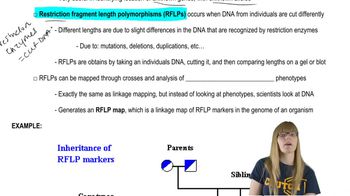
Mapping with Markers

Methylation and Its Effects

Methylation is a biochemical process involving the addition of a methyl group to DNA, often affecting gene expression and the activity of restriction enzymes. In the context of restriction endonucleases, methylation can prevent enzyme binding and cleavage at specific sites, as seen with SmaI and CpG methylation. Recognizing how methylation influences enzyme activity is vital for understanding how mutations can alter restriction digestion patterns.
Recommended video:
Guided course
03:38
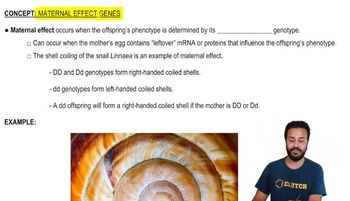
Maternal Effect

Mutation Detection via Restriction Analysis

Restriction analysis is a technique used to identify mutations by examining changes in DNA cleavage patterns. When a mutation occurs within a restriction site, it can prevent the enzyme from cutting the DNA, leading to different fragment sizes during gel electrophoresis. This method allows researchers to infer the presence of mutations based on the absence of expected cleavage, making it a powerful tool in genetic studies.
Recommended video:
Related Practice
Textbook Question

Using your knowledge of DNA repair pathways, choose the pathway that would be used to repair the following types of DNA damage. Explain your reasoning.

A double-stranded break that occurs during G1 and prevents completion of DNA replication

464
views
Textbook Question

Using your knowledge of DNA repair pathways, choose the pathway that would be used to repair the following types of DNA damage. Explain your reasoning.

A cytosine that has been deaminated to uracil

399
views
Textbook Question
Ataxia telangiectasia (OMIM 208900) is a human inherited disorder characterized by poor coordination (ataxia), red marks on the face (telangiectasia), increased sensitivity to X-rays and other radiation, and an increased susceptibility to cancer. Recent studies have shown that this disorder occurs as a result of mutation of the ATM gene. Propose a mechanism for how a mutation in the ATM gene leads to the characteristics associated with the disorder. Be sure to relate the symptoms of this disorder to functions of the ATM protein. Further, explain why DNA repair mechanisms cannot correct this problem.
477
views
Textbook Question

A geneticist searching for mutations uses the restriction endonucleases SmaI and PvuII to search for mutations that eliminate restriction sites. SmaI will not cleave DNA with CpG methylation. It cleaves DNA at the restriction digestion sequence ↓ 5′−CCC GGG−3′ 3′−GGG CCC−3′ ↑ PvuII is not sensitive to CpG methylation. It cleaves DNA at the restriction sequence ↓ 5′−CAG CTG−3′ 3′−GTC GAC−5′ ↑ What process is the researcher intending to detect with the use of these restriction enzymes?

488
views
Textbook Question

A geneticist searching for mutations uses the restriction endonucleases SmaI and PvuII to search for mutations that eliminate restriction sites. SmaI will not cleave DNA with CpG methylation. It cleaves DNA at the restriction digestion sequence ↓ 5′−CCC GGG−3′ 3′−GGG CCC−3′ ↑ PvuII is not sensitive to CpG methylation. It cleaves DNA at the restriction sequence ↓ 5′−CAG CTG−3′ 3′−GTC GAC−5′ ↑ Explain why CpG dinucleotides are hotspots of mutation.

437
views
Textbook Question

In a mouse-breeding experiment a new mutation called Dumbo is identified. A mouse with the Dumbo mutation has very large ears. It is produced by two parental mice with normal ear size. Based on this information, can you tell whether the Dumbo mutation is a regulatory mutation or a mutation of a protein-coding gene? Why or why not?

415
views