Pearson+ LogoPearson+ Logo
Ch. 11 - Gene Mutation, DNA Repair, and Homologous Recombination
Sanders - Genetic Analysis: An Integrated Approach 3rd Edition
Sanders3rd EditionGenetic Analysis: An Integrated ApproachISBN: 9780135564172Not the one you use?Change textbook
Chapter 11, Problem 34e

Using your knowledge of DNA repair pathways, choose the pathway that would be used to repair the following types of DNA damage. Explain your reasoning.
A double-stranded break that occurs during G1 and prevents completion of DNA replication

Verified step by step guidance
1
Step 1: Identify the type of DNA damage described in the problem. A double-stranded break (DSB) is a severe form of DNA damage where both strands of the DNA helix are broken. This type of damage can prevent DNA replication and cell division if not repaired.
Step 2: Recognize the cell cycle phase mentioned in the problem. The damage occurs during the G₁ phase, which is the first gap phase before DNA replication begins in the S phase. This is important because the repair pathway used depends on the availability of a sister chromatid, which is only present after DNA replication.
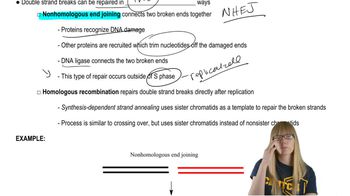
Step 3: Determine the DNA repair pathway suitable for the G₁ phase. Since the cell is in G₁ and no sister chromatid is available, the Non-Homologous End Joining (NHEJ) pathway is typically used to repair double-stranded breaks during this phase. NHEJ directly ligates the broken DNA ends without requiring a homologous template.
Step 4: Explain the reasoning behind the choice of NHEJ. NHEJ is active throughout the cell cycle but is particularly important in G₁ because it does not rely on homologous recombination, which requires a sister chromatid. While NHEJ is error-prone and may lead to small insertions or deletions, it is the primary mechanism for repairing DSBs in G₁.
Step 5: Conclude by emphasizing the importance of repairing double-stranded breaks promptly. If left unrepaired, DSBs can lead to genomic instability, cell cycle arrest, or apoptosis. NHEJ ensures the cell can proceed to the next phase of the cycle despite the absence of a homologous template.

Verified video answer for a similar problem:

This video solution was recommended by our tutors as helpful for the problem above.
Video duration:
3m
Was this helpful?

Key Concepts

Here are the essential concepts you must grasp in order to answer the question correctly.

Double-Stranded Breaks (DSBs)

Double-stranded breaks are severe forms of DNA damage where both strands of the DNA helix are broken. This type of damage can lead to genomic instability if not repaired properly, as it can result in the loss of genetic information or chromosomal rearrangements. DSBs can occur due to various factors, including ionizing radiation, chemical agents, or during normal cellular processes like DNA replication.
Recommended video:
Guided course
03:03
Double Strand Breaks

Homologous Recombination (HR)

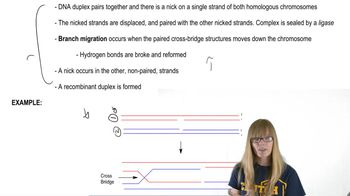
Homologous recombination is a critical DNA repair pathway that repairs double-stranded breaks using a homologous sequence as a template. This process is most active during the S and G₂ phases of the cell cycle when sister chromatids are available. HR is a precise repair mechanism that ensures the accurate restoration of the original DNA sequence, thus maintaining genomic integrity.
Recommended video:
Guided course
03:51
Recombination after Single Strand Breaks

Non-Homologous End Joining (NHEJ)

Non-homologous end joining is a DNA repair pathway that directly ligates the broken ends of DNA without the need for a homologous template. This pathway is predominant in the G₁ phase of the cell cycle, making it crucial for repairing double-stranded breaks that occur before DNA replication. While NHEJ is faster and more efficient, it can lead to insertions or deletions at the repair site, potentially causing mutations.
Recommended video:
Guided course
03:03
Double Strand Breaks
Related Practice
Textbook Question

Using your knowledge of DNA repair pathways, choose the pathway that would be used to repair the following types of DNA damage. Explain your reasoning.

Heavily damaged bacterial DNA

861
views
Textbook Question

Using your knowledge of DNA repair pathways, choose the pathway that would be used to repair the following types of DNA damage. Explain your reasoning.

A thymine dimer induced as a result of UV exposure

707
views
Textbook Question

Using your knowledge of DNA repair pathways, choose the pathway that would be used to repair the following types of DNA damage. Explain your reasoning.

A double-strand break that occurs just after replication in an actively dividing cell

539
views
Textbook Question

Using your knowledge of DNA repair pathways, choose the pathway that would be used to repair the following types of DNA damage. Explain your reasoning.

A cytosine that has been deaminated to uracil

399
views
Textbook Question
Ataxia telangiectasia (OMIM 208900) is a human inherited disorder characterized by poor coordination (ataxia), red marks on the face (telangiectasia), increased sensitivity to X-rays and other radiation, and an increased susceptibility to cancer. Recent studies have shown that this disorder occurs as a result of mutation of the ATM gene. Propose a mechanism for how a mutation in the ATM gene leads to the characteristics associated with the disorder. Be sure to relate the symptoms of this disorder to functions of the ATM protein. Further, explain why DNA repair mechanisms cannot correct this problem.
477
views
Textbook Question

A geneticist searching for mutations uses the restriction endonucleases SmaI and PvuII to search for mutations that eliminate restriction sites. SmaI will not cleave DNA with CpG methylation. It cleaves DNA at the restriction digestion sequence ↓ 5′−CCC GGG−3′ 3′−GGG CCC−3′ ↑ PvuII is not sensitive to CpG methylation. It cleaves DNA at the restriction sequence ↓ 5′−CAG CTG−3′ 3′−GTC GAC−5′ ↑ What common feature do SmaI and PvuII share that would be useful to a researcher searching for mutations that disrupt restriction digestion?

409
views