Pearson+ LogoPearson+ Logo
Ch. 11 - Gene Mutation, DNA Repair, and Homologous Recombination
Sanders - Genetic Analysis: An Integrated Approach 3rd Edition
Sanders3rd EditionGenetic Analysis: An Integrated ApproachISBN: 9780135564172Not the one you use?Change textbook
Chapter 11, Problem 1

Identify two general ways chemical mutagens can alter DNA. Give examples of these two mechanisms.

Verified step by step guidance
1
Understand that chemical mutagens are agents that can cause changes in the DNA sequence, leading to mutations.
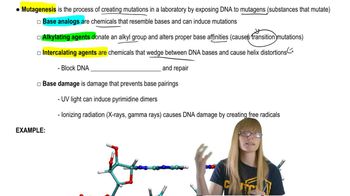
Recognize that one general way chemical mutagens can alter DNA is through base modification, where the chemical structure of a DNA base is altered. An example of this is alkylating agents, which add alkyl groups to DNA bases, leading to mispairing during replication.
Identify another way chemical mutagens can alter DNA is through base analog incorporation, where chemicals that resemble DNA bases are incorporated into DNA during replication. An example is 5-bromouracil, which can substitute for thymine and pair with guanine instead of adenine, causing mutations.
Consider how these alterations can lead to point mutations, which are changes in a single nucleotide pair in the DNA sequence.
Reflect on the broader implications of these mutations, such as how they can lead to genetic disorders or contribute to the development of cancer.

Verified video answer for a similar problem:

This video solution was recommended by our tutors as helpful for the problem above.
Video duration:
2m
Was this helpful?

Key Concepts

Here are the essential concepts you must grasp in order to answer the question correctly.

Chemical Mutagens

Chemical mutagens are substances that can cause changes in the DNA sequence of an organism. They can interact with DNA directly or indirectly, leading to mutations. Common examples include base analogs, which mimic normal DNA bases, and alkylating agents, which add alkyl groups to DNA, altering its structure and function.
Recommended video:
Guided course
04:29
Induced Mutations

Base Substitution

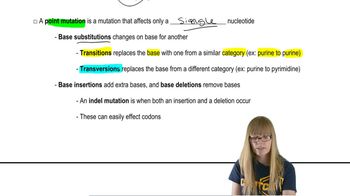
Base substitution is a type of mutation where one nucleotide in the DNA sequence is replaced by another. This can lead to changes in the amino acid sequence of proteins, potentially altering their function. An example is the incorporation of a base analog during DNA replication, which can result in a permanent change in the genetic code.
Recommended video:
Guided course
03:49
Base Distortions

Frameshift Mutation

Frameshift mutations occur when nucleotides are added or deleted from the DNA sequence, shifting the reading frame of the genetic code. This can drastically change the resulting protein, often leading to nonfunctional proteins. An example is the action of intercalating agents, which insert themselves between DNA bases, causing insertions or deletions during replication.
Recommended video:
Guided course
09:49
Point Mutations
Related Practice
Textbook Question

In March 2011 an earthquake measuring approximately 9.0 on the Richter scale struck Fukushima, Japan. Several nuclear reactors at the Fukushima Daichii Nuclear Power Plant were damaged, and nuclear core meltdown occurred. A massive release of radiation accompanied damage to the plant, and 5 years later the incidence of thyroid cancer in children exposed to the radiation was determined to be well over 100 times more frequent than expected without radiation exposure. DNA damage and mutations resulting from radiation exposure are suspected of causing this increased cancer rate. What gene discussed in this chapter might be responsible for pausing the cell cycle of dividing cells long enough for radiation-induced damage to be repaired in cells?

413
views
Textbook Question

In March 2011 an earthquake measuring approximately 9.0 on the Richter scale struck Fukushima, Japan. Several nuclear reactors at the Fukushima Daichii Nuclear Power Plant were damaged, and nuclear core meltdown occurred. A massive release of radiation accompanied damage to the plant, and 5 years later the incidence of thyroid cancer in children exposed to the radiation was determined to be well over 100 times more frequent than expected without radiation exposure. DNA damage and mutations resulting from radiation exposure are suspected of causing this increased cancer rate. Do you think it is possible that significant increases in the incidence of other types of cancer will occur in the future among people who were exposed to the Fukushima radiation? Why?

464
views
Textbook Question

For the retinal cancer retinoblastoma, the inheritance of one mutated copy of RB1 from one of the parents is often referred to as a mutation that produces a 'dominant predisposition to cancer.' This means that the first mutation does not produce cancer but makes it very likely that cancer will develop. Define the 'two-hit hypothesis' for retinoblastoma.

519
views
Textbook Question

Nitrous acid and 5-bromodeoxyuracil (BrdU) alter DNA by different mechanisms. What type of mutation does each compound produce?

603
views
Textbook Question

What is the difference between a transition mutation and a transversion mutation?

1141
views
Textbook Question

What are the differences between a synonymous mutation, a missense mutation, and a nonsense mutation?

914
views