Pearson+ LogoPearson+ Logo
Ch. 11 - Gene Mutation, DNA Repair, and Homologous Recombination
Sanders - Genetic Analysis: An Integrated Approach 3rd Edition
Sanders3rd EditionGenetic Analysis: An Integrated ApproachISBN: 9780135564172Not the one you use?Change textbook
Chapter 11, Problem 3

What is the difference between a transition mutation and a transversion mutation?

Verified step by step guidance
1
Understand that mutations are changes in the DNA sequence, and they can be classified based on the type of nucleotide change.
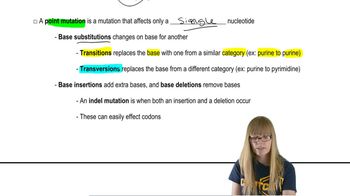
Recognize that a transition mutation is a type of point mutation where a purine is replaced with another purine (A ↔ G) or a pyrimidine is replaced with another pyrimidine (C ↔ T).
Identify that a transversion mutation is another type of point mutation where a purine is replaced with a pyrimidine or vice versa (A or G ↔ C or T).
Note that transitions are more common than transversions because they involve less drastic changes in the DNA structure.
Consider the implications of these mutations: transitions may have less impact on the protein function compared to transversions, which can lead to more significant changes in the amino acid sequence.

Verified video answer for a similar problem:

This video solution was recommended by our tutors as helpful for the problem above.
Video duration:
2m
Was this helpful?

Key Concepts

Here are the essential concepts you must grasp in order to answer the question correctly.

Transition Mutation

A transition mutation is a type of point mutation where a purine base (adenine or guanine) is replaced by another purine, or a pyrimidine base (cytosine or thymine) is replaced by another pyrimidine. This type of mutation is more common than transversion mutations and often has less impact on the protein structure, as it maintains the same class of nucleotide.
Recommended video:
Guided course
09:49
Point Mutations

Transversion Mutation

A transversion mutation is another type of point mutation, but it involves the substitution of a purine for a pyrimidine or vice versa. This means that adenine or guanine can be replaced by cytosine or thymine, leading to a more significant change in the DNA sequence. Transversions are less frequent than transitions and can have a greater impact on the resulting protein.
Recommended video:
Guided course
09:49
Point Mutations

Impact on Protein Function

Both transition and transversion mutations can affect protein function, but their impacts can vary. Transition mutations are often less disruptive due to the preservation of the nucleotide class, while transversions can lead to more drastic changes in amino acid sequences, potentially altering protein structure and function. Understanding these differences is crucial for predicting the effects of mutations in genetic studies.
Recommended video: