Textbook Question
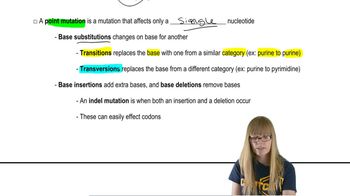
What is the difference between a transition mutation and a transversion mutation?
1141
views

 Sanders 3rd EditionCh. 11 - Gene Mutation, DNA Repair, and Homologous RecombinationProblem 4
 Verified step by step guidance
 09:49
09:49 09:49 09:49
What is the difference between a transition mutation and a transversion mutation?
Nitrous acid and 5-bromodeoxyuracil (BrdU) alter DNA by different mechanisms. What type of mutation does each compound produce?
In March 2011 an earthquake measuring approximately 9.0 on the Richter scale struck Fukushima, Japan. Several nuclear reactors at the Fukushima Daichii Nuclear Power Plant were damaged, and nuclear core meltdown occurred. A massive release of radiation accompanied damage to the plant, and 5 years later the incidence of thyroid cancer in children exposed to the radiation was determined to be well over 100 times more frequent than expected without radiation exposure. DNA damage and mutations resulting from radiation exposure are suspected of causing this increased cancer rate. What gene discussed in this chapter might be responsible for pausing the cell cycle of dividing cells long enough for radiation-induced damage to be repaired in cells?
UV irradiation causes damage to bacterial DNA. What kind of damage is frequently caused and how does photolyase repair the damage?
For the retinal cancer retinoblastoma, the inheritance of one mutated copy of RB1 from one of the parents is often referred to as a mutation that produces a 'dominant predisposition to cancer.' This means that the first mutation does not produce cancer but makes it very likely that cancer will develop. Define the 'two-hit hypothesis' for retinoblastoma.
In March 2011 an earthquake measuring approximately 9.0 on the Richter scale struck Fukushima, Japan. Several nuclear reactors at the Fukushima Daichii Nuclear Power Plant were damaged, and nuclear core meltdown occurred. A massive release of radiation accompanied damage to the plant, and 5 years later the incidence of thyroid cancer in children exposed to the radiation was determined to be well over 100 times more frequent than expected without radiation exposure. DNA damage and mutations resulting from radiation exposure are suspected of causing this increased cancer rate. Do you think it is possible that significant increases in the incidence of other types of cancer will occur in the future among people who were exposed to the Fukushima radiation? Why?