Pearson+ LogoPearson+ Logo
Ch. 11 - Gene Mutation, DNA Repair, and Homologous Recombination
Sanders - Genetic Analysis: An Integrated Approach 3rd Edition
Sanders3rd EditionGenetic Analysis: An Integrated ApproachISBN: 9780135564172Not the one you use?Change textbook
Chapter 11, Problem 14b

Several types of mutation are identified and described in the chapter. These include (1) promoter mutation, (2) splice site mutation, (3) missense mutation, (4) frameshift mutation, and 5) nonsense mutation. Match the following mutation descriptions with the type(s) of mutations listed above. More than one mutation type might match a description.


A mutation that produces about 5% of the wild-type amount of an mRNA.

Verified step by step guidance
1
Understand the problem: The question asks us to match the description of a mutation that produces about 5% of the wild-type amount of an mRNA with one or more of the mutation types listed. The mutation types include promoter mutation, splice site mutation, missense mutation, frameshift mutation, and nonsense mutation.
Review the mutation types: Recall that promoter mutations affect the binding of RNA polymerase or transcription factors, potentially reducing transcription levels. Splice site mutations disrupt proper RNA splicing, potentially leading to reduced or altered mRNA. Missense mutations change a single amino acid in the protein, frameshift mutations alter the reading frame, and nonsense mutations introduce a premature stop codon.
Focus on the description: The key detail is that the mutation results in about 5% of the wild-type amount of mRNA. This suggests a significant reduction in mRNA levels, which is most likely due to a mutation affecting transcription or RNA processing.
Eliminate unlikely options: Missense, frameshift, and nonsense mutations primarily affect the protein sequence or function, not the amount of mRNA produced. Therefore, these are unlikely to match the description.
Match the description: Promoter mutations can reduce transcription efficiency, leading to lower mRNA levels. Splice site mutations can lead to improper splicing, which may result in reduced mRNA stability or production. Both promoter and splice site mutations are plausible matches for this description.

Verified video answer for a similar problem:

This video solution was recommended by our tutors as helpful for the problem above.
Video duration:
1m
Was this helpful?

Key Concepts

Here are the essential concepts you must grasp in order to answer the question correctly.

Promoter Mutation

A promoter mutation occurs in the DNA sequence that regulates the transcription of a gene. This type of mutation can affect the binding of RNA polymerase and transcription factors, potentially leading to reduced levels of mRNA. If the mutation significantly impairs promoter function, it may result in a drastic decrease in mRNA production, such as the 5% of wild-type levels mentioned.
Recommended video:
Guided course
10:48
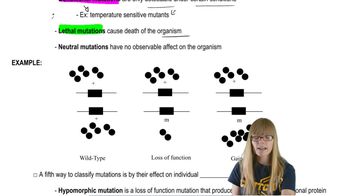
Mutations and Phenotypes

Nonsense Mutation

A nonsense mutation is a type of point mutation where a single nucleotide change results in a premature stop codon in the mRNA sequence. This leads to the production of a truncated protein that is often nonfunctional. If a nonsense mutation occurs in a critical region of a gene, it can severely reduce the amount of functional mRNA and protein, potentially aligning with the 5% wild-type mRNA level.
Recommended video:
Guided course
09:49
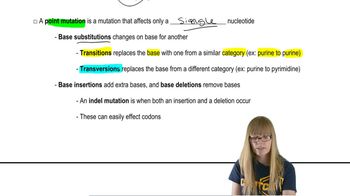
Point Mutations

Splice Site Mutation

A splice site mutation affects the regions of pre-mRNA that are necessary for proper splicing, which is the process of removing introns and joining exons. Such mutations can lead to the inclusion of introns or exclusion of exons in the final mRNA transcript, resulting in abnormal mRNA levels. If splicing is disrupted, it can lead to a significant reduction in the amount of mature mRNA produced, possibly matching the described 5% of wild-type levels.
Recommended video:
Guided course
10:48
Mutations and Phenotypes
Related Practice
Textbook Question

Answer the following questions concerning the accuracy of DNA polymerase during replication.

If the kind of abnormality identified in part (c) is not corrected before the next DNA replication cycle, what kind of mutation occurs?

421
views
Textbook Question

Answer the following questions concerning the accuracy of DNA polymerase during replication.

DNA mismatch repair can accurately distinguish between the template strand and the newly replicated strand of a DNA duplex. What characteristic of DNA strands is used to make this distinction?

457
views
Textbook Question

Several types of mutation are identified and described. These include (1) promoter mutation, (2) splice site mutation, (3) missense mutation, (4) frameshift mutation, and 5) nonsense mutation. Match the following mutation descriptions with the type(s) of mutations listed above. More than one mutation type might match a description.


A mutation that changes several amino acids in a protein and results in a protein that is shorter than the wild-type product.

846
views
Textbook Question

Several types of mutation are identified and described in the chapter. These include (1) promoter mutation, (2) splice site mutation, (3) missense mutation, (4) frameshift mutation, and 5) nonsense mutation. Match the following mutation descriptions with the type(s) of mutations listed above. More than one mutation type might match a description.


A mutation that produces a mutant protein that differs from the wild-type protein at one amino acid position.

996
views
Textbook Question

Several types of mutation are identified and described in the chapter. These include (1) promoter mutation, (2) splice site mutation, (3) missense mutation, (4) frameshift mutation, and 5) nonsense mutation. Match the following mutation descriptions with the type(s) of mutations listed above. More than one mutation type might match a description.


A mutation that produces a protein that is shorter than the wild-type protein but does not have any amino acid changes in the portion produced.

618
views
Textbook Question

Several types of mutation are identified and described in the chapter. These include (1) promoter mutation, (2) splice site mutation, (3) missense mutation, (4) frameshift mutation, and 5) nonsense mutation. Match the following mutation descriptions with the type(s) of mutations listed above. More than one mutation type might match a description.


A null mutation that does not produce any functional protein product.

513
views