Answer the following questions concerning the accuracy of DNA polymerase during replication.
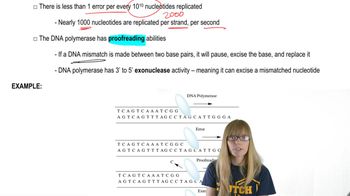
If a DNA replication error is detected by DNA polymerase, how is it corrected?

Sanders 3rd Edition
Ch. 11 - Gene Mutation, DNA Repair, and Homologous Recombination
Problem 13e
Verified step by step guidance
Answer the following questions concerning the accuracy of DNA polymerase during replication.
If a DNA replication error is detected by DNA polymerase, how is it corrected?
Answer the following questions concerning the accuracy of DNA polymerase during replication.
If a replication error escapes detection and correction, what kind of abnormality is most likely to exist at the site of the replication error?
Answer the following questions concerning the accuracy of DNA polymerase during replication.
Identify two mechanisms that can correct the kind of abnormality resulting from the circumstances identified in part (c).
Answer the following questions concerning the accuracy of DNA polymerase during replication.
DNA mismatch repair can accurately distinguish between the template strand and the newly replicated strand of a DNA duplex. What characteristic of DNA strands is used to make this distinction?
Several types of mutation are identified and described. These include (1) promoter mutation, (2) splice site mutation, (3) missense mutation, (4) frameshift mutation, and 5) nonsense mutation. Match the following mutation descriptions with the type(s) of mutations listed above. More than one mutation type might match a description.
A mutation that changes several amino acids in a protein and results in a protein that is shorter than the wild-type product.
Several types of mutation are identified and described in the chapter. These include (1) promoter mutation, (2) splice site mutation, (3) missense mutation, (4) frameshift mutation, and 5) nonsense mutation. Match the following mutation descriptions with the type(s) of mutations listed above. More than one mutation type might match a description.
A mutation that produces about 5% of the wild-type amount of an mRNA.