Pearson+ LogoPearson+ Logo
Ch. 11 - Gene Mutation, DNA Repair, and Homologous Recombination
Sanders - Genetic Analysis: An Integrated Approach 3rd Edition
Sanders3rd EditionGenetic Analysis: An Integrated ApproachISBN: 9780135564172Not the one you use?Change textbook
Chapter 11, Problem 13f

Answer the following questions concerning the accuracy of DNA polymerase during replication.
DNA mismatch repair can accurately distinguish between the template strand and the newly replicated strand of a DNA duplex. What characteristic of DNA strands is used to make this distinction?

Verified step by step guidance
1
Understand the role of DNA mismatch repair: DNA mismatch repair is a system that corrects errors introduced during DNA replication, such as mismatched base pairs.
Recognize the key characteristic used for strand distinction: DNA mismatch repair relies on the fact that the newly synthesized strand is not yet fully modified compared to the template strand.
Explain the specific modification: In prokaryotes, the template strand is methylated at specific sites (e.g., adenine residues in GATC sequences), while the newly synthesized strand is temporarily unmethylated.
Describe how this distinction is utilized: The mismatch repair machinery identifies the unmethylated strand as the newly synthesized strand and corrects errors on this strand to match the template strand.
Highlight the importance of timing: The methylation of the newly synthesized strand occurs after a short delay, allowing the repair system to distinguish between the strands during replication.

Verified video answer for a similar problem:

This video solution was recommended by our tutors as helpful for the problem above.
Video duration:
2m
Was this helpful?

Key Concepts

Here are the essential concepts you must grasp in order to answer the question correctly.

DNA Mismatch Repair

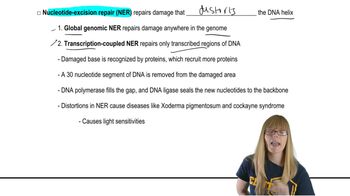
DNA mismatch repair is a cellular mechanism that corrects errors that occur during DNA replication. It identifies and repairs mismatched base pairs, ensuring the fidelity of DNA synthesis. This process is crucial for maintaining genetic stability and preventing mutations that could lead to diseases, including cancer.
Recommended video:
Guided course
05:44
Repair Pathways

Template Strand vs. Newly Synthesized Strand

During DNA replication, the original DNA strand is referred to as the template strand, while the newly synthesized strand is created based on this template. The distinction between these two strands is essential for mismatch repair, as the repair machinery must recognize which strand contains the correct sequence and which contains the error.
Recommended video:
Guided course
03:03
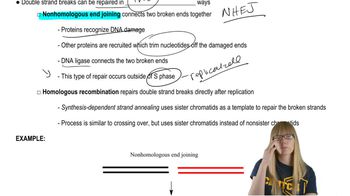
Double Strand Breaks

DNA Strand Methylation

One key characteristic used to distinguish between the template and newly synthesized strands is DNA strand methylation. In many organisms, the template strand is often methylated, while the newly synthesized strand is not immediately methylated. This difference allows the mismatch repair system to identify and correct errors by targeting the unmethylated strand.
Recommended video:
Guided course
03:03
Double Strand Breaks
Related Practice
Textbook Question

Answer the following questions concerning the accuracy of DNA polymerase during replication.

If a replication error escapes detection and correction, what kind of abnormality is most likely to exist at the site of the replication error?

437
views
Textbook Question

Answer the following questions concerning the accuracy of DNA polymerase during replication.

Identify two mechanisms that can correct the kind of abnormality resulting from the circumstances identified in part (c).

453
views
Textbook Question

Answer the following questions concerning the accuracy of DNA polymerase during replication.

If the kind of abnormality identified in part (c) is not corrected before the next DNA replication cycle, what kind of mutation occurs?

421
views
Textbook Question

Several types of mutation are identified and described. These include (1) promoter mutation, (2) splice site mutation, (3) missense mutation, (4) frameshift mutation, and 5) nonsense mutation. Match the following mutation descriptions with the type(s) of mutations listed above. More than one mutation type might match a description.


A mutation that changes several amino acids in a protein and results in a protein that is shorter than the wild-type product.

846
views
Textbook Question

Several types of mutation are identified and described in the chapter. These include (1) promoter mutation, (2) splice site mutation, (3) missense mutation, (4) frameshift mutation, and 5) nonsense mutation. Match the following mutation descriptions with the type(s) of mutations listed above. More than one mutation type might match a description.


A mutation that produces about 5% of the wild-type amount of an mRNA.

562
views
Textbook Question

Several types of mutation are identified and described in the chapter. These include (1) promoter mutation, (2) splice site mutation, (3) missense mutation, (4) frameshift mutation, and 5) nonsense mutation. Match the following mutation descriptions with the type(s) of mutations listed above. More than one mutation type might match a description.


A mutation that produces a mutant protein that differs from the wild-type protein at one amino acid position.

996
views