Pearson+ LogoPearson+ Logo
Ch. 12 - Regulation of Gene Expression in Bacteria and Bacteriophage
Sanders - Genetic Analysis: An Integrated Approach 3rd Edition
Sanders3rd EditionGenetic Analysis: An Integrated ApproachISBN: 9780135564172Not the one you use?Change textbook
Chapter 12, Problem 22b

Suppose the lac operon partial diploid cap⁻ I⁺ P⁺ O⁺ Z⁻ Y⁺cap⁺ I⁻ P⁺ O⁺ Z⁺ Y⁻ is grown.
Is transcription of β-galactosidase and permease inducible, constitutive, or noninducible?

Verified step by step guidance
1
Understand the components of the lac operon: The lac operon is a set of genes involved in lactose metabolism in bacteria. It includes structural genes (Z for β-galactosidase, Y for permease), regulatory elements (I for the repressor, P for the promoter, O for the operator), and CAP (catabolite activator protein) for positive regulation.
Analyze the genotype of the partial diploid: The genotype is cap⁻ I⁺ P⁺ O⁺ Z⁻ Y⁺ / cap⁺ I⁻ P⁺ O⁺ Z⁺ Y⁻. This means there are two copies of the operon. The first copy has a defective CAP (cap⁻), a functional repressor (I⁺), a functional promoter (P⁺), a functional operator (O⁺), a defective β-galactosidase gene (Z⁻), and a functional permease gene (Y⁺). The second copy has a functional CAP (cap⁺), a defective repressor (I⁻), a functional promoter (P⁺), a functional operator (O⁺), a functional β-galactosidase gene (Z⁺), and a defective permease gene (Y⁻).
Determine the role of CAP: CAP is required for efficient transcription of the lac operon in the presence of lactose and low glucose. Since one copy of the operon has a functional CAP (cap⁺), this copy can respond to glucose levels, while the other copy (cap⁻) cannot.
Evaluate the repressor's role: The I⁺ allele produces a functional repressor that can bind to the operator and block transcription in the absence of lactose. The I⁻ allele produces a nonfunctional repressor. Since the functional repressor (I⁺) is trans-dominant, it will regulate both copies of the operon.
Assess the transcriptional outcome: In the presence of lactose, the functional repressor (I⁺) will be inactivated, allowing transcription of the operon. The functional CAP (cap⁺) will enhance transcription of the second copy of the operon. Therefore, β-galactosidase (Z⁺) and permease (Y⁺) will be inducible, as their transcription depends on the presence of lactose and low glucose.

Verified video answer for a similar problem:

This video solution was recommended by our tutors as helpful for the problem above.
Video duration:
2m
Was this helpful?

Key Concepts

Here are the essential concepts you must grasp in order to answer the question correctly.

Lac Operon Structure

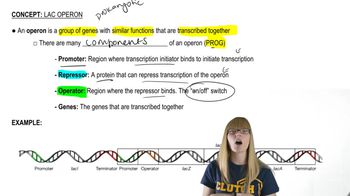
The lac operon is a set of genes in E. coli that are involved in the metabolism of lactose. It consists of structural genes (Z, Y, A) and regulatory elements (promoter P, operator O, and the repressor gene I). Understanding the operon's structure is crucial for determining how gene expression is regulated in response to lactose availability.
Recommended video:
Guided course
04:27
Lac Operon Overview

Inducible vs. Constitutive Expression

Inducible expression refers to genes that are turned on in response to specific signals, such as the presence of lactose in the case of the lac operon. In contrast, constitutive expression describes genes that are continuously active regardless of environmental conditions. Recognizing these terms helps in analyzing how the lac operon responds to different genetic configurations.
Recommended video:
Guided course
02:09
Penetrance and Expressivity

Partial Diploidy

Partial diploidy occurs when an organism has two copies of some genes but not others, often due to genetic manipulation. In the context of the lac operon, this can affect the expression of genes like Z and Y, leading to different phenotypic outcomes. Understanding partial diploidy is essential for predicting how mutations and gene interactions influence operon function.
Recommended video:
Guided course
27:36
Diploid Genetics
Related Practice
Textbook Question

Suppose each of the genotypes you listed in parts (a) and (b) of Problem 19 are placed in a partial diploid genotype along with a chromosome that has a fully wild-type lac operon.

Which partial diploids will be able to grow on a lactose medium?

557
views
Textbook Question

Four independent lac⁻ mutants (mutants A to D) are isolated in haploid strains of E. coli. The strains have the following phenotypic characteristics:

Mutant A is lac⁻, but transcription1 of operon genes is induced by lactose.

Mutant B is lac⁻ and has uninducible2 transcription of operon genes.

Mutant C is lac⁺ and has constitutive3 transcription of operon genes.

Mutant D is lac⁺ and has constitutive3 transcription of operon genes.

A microbiologist develops donor and recipient varieties of each mutant strain and crosses them with the results shown below. The table indicates whether inducible, constitutive, or noninducible transcription occurs, along with lac+ and lac⁻ growth habit for each partial diploid. Assume each strain has a single mutation.

Use this information to identify which lac operon gene is mutated in each strain.

612
views
Textbook Question

Suppose the lac operon partial diploid cap⁻ I⁺ P⁺ O⁺ Z⁻ Y⁺cap⁺ I⁻ P⁺ O⁺ Z⁺ Y⁻ is grown.

Will this partial diploid strain grow on a lactose medium?

927
views
Textbook Question

Suppose the lac operon partial diploid cap⁻ I⁺ P⁺ O⁺ Z⁻ Y⁺cap⁺ I⁻ P⁺ O⁺ Z⁺ Y⁻ is grown.

Explain how genetic complementation contributes to the growth habit of this strain.

844
views
Textbook Question

What is a riboswitch? Describe the riboswitch mechanism that regulates transcription of the thi operon in B. subtilus. What parallels can you see between this mechanism and the regulation of transcription of the trp operon in E. coli?

763
views
Textbook Question

A repressible operon system, like the trp operon, contains three genes, G, Z, and W. Operon genes are synthesized when the end product of the operon synthesis pathway is absent, but there is no synthesis when the end product is present. One of these genes is an operator, one is a regulatory protein, and the other is a structural enzyme involved in synthesis of the end product. In the table below, '+' indicates that the enzyme is synthesized by the operon and '−' means that no enzyme synthesis occurs. Use this information to determine which gene corresponds to each operon function.

1117
views