Pearson+ LogoPearson+ Logo
Ch. 12 - Regulation of Gene Expression in Bacteria and Bacteriophage
Sanders - Genetic Analysis: An Integrated Approach 3rd Edition
Sanders3rd EditionGenetic Analysis: An Integrated ApproachISBN: 9780135564172Not the one you use?Change textbook
Chapter 12, Problem 22a

Suppose the lac operon partial diploid cap⁻ I⁺ P⁺ O⁺ Z⁻ Y⁺cap⁺ I⁻ P⁺ O⁺ Z⁺ Y⁻ is grown.
Will this partial diploid strain grow on a lactose medium?

Verified step by step guidance
1
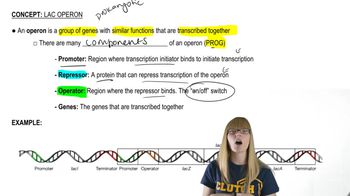
Step 1: Understand the components of the lac operon. The lac operon is a set of genes in bacteria that are involved in lactose metabolism. It includes the structural genes Z (β-galactosidase) and Y (permease), the promoter (P), the operator (O), the repressor gene (I), and the CAP site (catabolite activator protein binding site).
Step 2: Analyze the genotype of the partial diploid strain. The strain is cap⁻ I⁺ P⁺ O⁺ Z⁻ Y⁺ / cap⁺ I⁻ P⁺ O⁺ Z⁺ Y⁻. This means there are two copies of the lac operon: one with a defective CAP site (cap⁻) but functional I, P, O, and Y genes, and a second with a functional CAP site (cap⁺) but defective I and Y genes.
Step 3: Determine the functionality of the repressor (I) gene. The I⁺ allele on the first operon produces a functional repressor protein, which can regulate both operons in trans. The I⁻ allele on the second operon is nonfunctional, but this does not matter because the I⁺ allele is dominant.
Step 4: Evaluate the structural genes Z and Y. The Z⁻ allele on the first operon means β-galactosidase cannot be produced from that operon, but the Z⁺ allele on the second operon allows β-galactosidase production. Similarly, the Y⁺ allele on the first operon allows permease production, while the Y⁻ allele on the second operon does not. Both enzymes are required for lactose metabolism.
Step 5: Assess the impact of the CAP site. The cap⁻ mutation on the first operon means it cannot respond to catabolite repression, but the cap⁺ allele on the second operon allows proper regulation. Since both β-galactosidase and permease can be produced from the two operons, and the CAP site on the second operon is functional, the strain will grow on a lactose medium.

Verified video answer for a similar problem:

This video solution was recommended by our tutors as helpful for the problem above.
Video duration:
2m
Was this helpful?

Key Concepts

Here are the essential concepts you must grasp in order to answer the question correctly.

Lac Operon Structure

The lac operon is a set of genes in E. coli that are involved in the metabolism of lactose. It consists of structural genes (Z, Y, A) that encode proteins necessary for lactose uptake and breakdown, along with regulatory elements such as the promoter (P) and operator (O). Understanding the arrangement and function of these components is crucial for predicting the operon's behavior in the presence of lactose.
Recommended video:
Guided course
04:27
Lac Operon Overview

Partial Diploidy

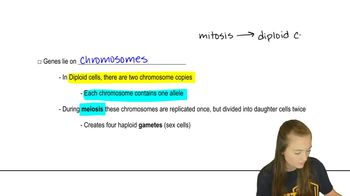
Partial diploidy refers to a genetic condition where an organism has two copies of some genes but not others, often due to the presence of a plasmid or a chromosomal segment. In the context of the lac operon, this means that the strain has two different alleles for some genes, which can affect the expression of the operon and its ability to metabolize lactose.
Recommended video:
Guided course
27:36
Diploid Genetics

Lactose Utilization

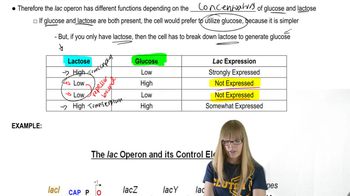
For a bacterial strain to grow on lactose medium, it must be able to transport lactose into the cell and metabolize it. This process is facilitated by the proteins encoded by the lac operon. The presence of functional genes (like Z and Y) is essential for lactose utilization, and mutations or deletions in these genes can prevent growth on lactose, making it important to analyze the specific alleles present in the given strain.
Recommended video:
Guided course
07:01
Lac Operon Summary
Related Practice
Textbook Question

Suppose each of the genotypes you listed in parts (a) and (b) of Problem 19 are placed in a partial diploid genotype along with a chromosome that has a fully wild-type lac operon.

Will the transcription of operon genes in each partial diploid be inducible or constitutive?

573
views
Textbook Question

Suppose each of the genotypes you listed in parts (a) and (b) of Problem 19 are placed in a partial diploid genotype along with a chromosome that has a fully wild-type lac operon.

Which partial diploids will be able to grow on a lactose medium?

557
views
Textbook Question

Four independent lac⁻ mutants (mutants A to D) are isolated in haploid strains of E. coli. The strains have the following phenotypic characteristics:

Mutant A is lac⁻, but transcription1 of operon genes is induced by lactose.

Mutant B is lac⁻ and has uninducible2 transcription of operon genes.

Mutant C is lac⁺ and has constitutive3 transcription of operon genes.

Mutant D is lac⁺ and has constitutive3 transcription of operon genes.

A microbiologist develops donor and recipient varieties of each mutant strain and crosses them with the results shown below. The table indicates whether inducible, constitutive, or noninducible transcription occurs, along with lac+ and lac⁻ growth habit for each partial diploid. Assume each strain has a single mutation.

Use this information to identify which lac operon gene is mutated in each strain.

612
views
Textbook Question

Suppose the lac operon partial diploid cap⁻ I⁺ P⁺ O⁺ Z⁻ Y⁺cap⁺ I⁻ P⁺ O⁺ Z⁺ Y⁻ is grown.

Is transcription of β-galactosidase and permease inducible, constitutive, or noninducible?

1268
views
Textbook Question

Suppose the lac operon partial diploid cap⁻ I⁺ P⁺ O⁺ Z⁻ Y⁺cap⁺ I⁻ P⁺ O⁺ Z⁺ Y⁻ is grown.

Explain how genetic complementation contributes to the growth habit of this strain.

844
views
Textbook Question

What is a riboswitch? Describe the riboswitch mechanism that regulates transcription of the thi operon in B. subtilus. What parallels can you see between this mechanism and the regulation of transcription of the trp operon in E. coli?

763
views