Pearson+ LogoPearson+ Logo
Ch. 12 - Regulation of Gene Expression in Bacteria and Bacteriophage
Sanders - Genetic Analysis: An Integrated Approach 3rd Edition
Sanders3rd EditionGenetic Analysis: An Integrated ApproachISBN: 9780135564172Not the one you use?Change textbook
Chapter 12, Problem 23

What is a riboswitch? Describe the riboswitch mechanism that regulates transcription of the thi operon in B. subtilus. What parallels can you see between this mechanism and the regulation of transcription of the trp operon in E. coli?

Verified step by step guidance
1
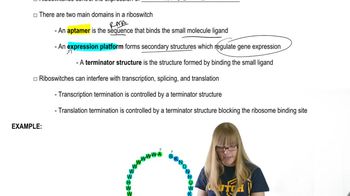
A riboswitch is a regulatory segment of an mRNA molecule that can bind a small molecule ligand directly, causing a conformational change in the mRNA structure. This change influences gene expression by affecting transcription or translation.
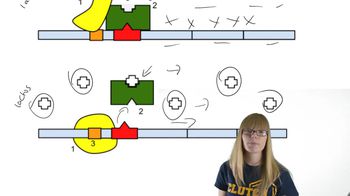
To regulate transcription of the thi operon in *Bacillus subtilis*, the riboswitch mechanism involves the binding of thiamine pyrophosphate (TPP), a derivative of vitamin B1, to the riboswitch located in the leader sequence of the mRNA. When TPP levels are high, it binds to the riboswitch, stabilizing a structure that forms a transcription termination signal, halting transcription of the thi operon.
When TPP levels are low, the riboswitch does not bind TPP, allowing the mRNA to adopt a structure that permits transcription of the thi operon, leading to the production of enzymes involved in thiamine biosynthesis.
The regulation of the thi operon in *B. subtilis* parallels the regulation of the trp operon in *E. coli* in that both systems use feedback mechanisms to control transcription based on the availability of a metabolite. In the trp operon, high levels of tryptophan activate a repressor protein that binds to the operator region, preventing transcription. Similarly, high levels of TPP bind to the riboswitch, halting transcription of the thi operon.
Both mechanisms exemplify how cells conserve energy and resources by regulating gene expression in response to metabolite concentrations, ensuring that biosynthetic pathways are active only when their products are needed.

Verified video answer for a similar problem:

This video solution was recommended by our tutors as helpful for the problem above.
Video duration:
2m
Was this helpful?

Key Concepts

Here are the essential concepts you must grasp in order to answer the question correctly.

Riboswitches

Riboswitches are regulatory segments of RNA that can bind small molecules, leading to changes in gene expression. They typically exist in the untranslated regions of mRNA and can influence transcription or translation by altering the RNA structure in response to the presence of specific metabolites.
Recommended video:

Thi Operon Regulation in B. subtilis

The thi operon in Bacillus subtilis is regulated by a riboswitch that responds to thiamine (vitamin B1) levels. When thiamine is abundant, it binds to the riboswitch, causing a conformational change that promotes the formation of a transcription terminator, halting transcription. Conversely, low thiamine levels lead to the formation of an anti-terminator structure, allowing transcription to proceed.
Recommended video:
Guided course
06:55
Lac Operon Regulation

Trp Operon Regulation in E. coli

The trp operon in Escherichia coli is also regulated by a riboswitch mechanism, but it primarily responds to tryptophan levels. High tryptophan concentrations lead to the formation of a transcription terminator, while low levels allow for the anti-terminator structure to form, enabling transcription. This mechanism highlights a common theme in bacterial gene regulation, where nutrient availability directly influences gene expression.
Recommended video:
Guided course
06:55
Lac Operon Regulation
Related Practice
Textbook Question

Suppose the lac operon partial diploid cap⁻ I⁺ P⁺ O⁺ Z⁻ Y⁺cap⁺ I⁻ P⁺ O⁺ Z⁺ Y⁻ is grown.

Will this partial diploid strain grow on a lactose medium?

927
views
Textbook Question

Suppose the lac operon partial diploid cap⁻ I⁺ P⁺ O⁺ Z⁻ Y⁺cap⁺ I⁻ P⁺ O⁺ Z⁺ Y⁻ is grown.

Is transcription of β-galactosidase and permease inducible, constitutive, or noninducible?

1268
views
Textbook Question

Suppose the lac operon partial diploid cap⁻ I⁺ P⁺ O⁺ Z⁻ Y⁺cap⁺ I⁻ P⁺ O⁺ Z⁺ Y⁻ is grown.

Explain how genetic complementation contributes to the growth habit of this strain.

844
views
Textbook Question

A repressible operon system, like the trp operon, contains three genes, G, Z, and W. Operon genes are synthesized when the end product of the operon synthesis pathway is absent, but there is no synthesis when the end product is present. One of these genes is an operator, one is a regulatory protein, and the other is a structural enzyme involved in synthesis of the end product. In the table below, '+' indicates that the enzyme is synthesized by the operon and '−' means that no enzyme synthesis occurs. Use this information to determine which gene corresponds to each operon function.

1117
views
Textbook Question

What is the likely effect of each of the following mutations of the trpL region on attenuation control of trp operon gene transcription? Explain your reasoning.

Region 3 is deleted.

512
views
Textbook Question

What is the likely effect of each of the following mutations of the trpL region on attenuation control of trp operon gene transcription? Explain your reasoning.

Region 4 is deleted.

426
views