Pearson+ LogoPearson+ Logo
Ch. 13 - Regulation of Gene Expression in Eukaryotes
Sanders - Genetic Analysis: An Integrated Approach 3rd Edition
Sanders3rd EditionGenetic Analysis: An Integrated ApproachISBN: 9780135564172Not the one you use?Change textbook
Chapter 13, Problem 2d

Describe and give an example (real or hypothetical) of each of the following:
Enhanceosome action

Verified step by step guidance
1
Understand the concept of an enhanceosome: An enhanceosome is a complex of proteins that assembles on an enhancer region of DNA to regulate the transcription of a target gene. Enhancers are DNA sequences that can increase the transcription of genes, even if they are located far from the gene they regulate.
Explain the mechanism of enhanceosome action: Enhanceosomes function by recruiting transcription factors and coactivators to the enhancer region. These proteins work together to stabilize the transcription machinery at the promoter region of the gene, facilitating efficient transcription.
Provide an example of enhanceosome action: A well-studied example is the enhanceosome that regulates the interferon-beta (IFN-β) gene. This gene is activated in response to viral infection. The enhanceosome forms at the enhancer region of the IFN-β gene and includes transcription factors such as NF-κB, IRF-3, IRF-7, and ATF-2/c-Jun.
Describe the cooperative binding of transcription factors: In the IFN-β enhanceosome, the transcription factors bind cooperatively to their respective binding sites on the enhancer. This cooperative binding ensures that the enhanceosome assembles only under specific conditions, such as during a viral infection.
Explain the role of coactivators and chromatin remodeling: Once the enhanceosome is assembled, it recruits coactivators like CBP/p300, which modify chromatin structure (e.g., through histone acetylation) to make the DNA more accessible. This facilitates the recruitment of RNA polymerase II and the transcription machinery to the promoter, leading to gene activation.

Verified video answer for a similar problem:

This video solution was recommended by our tutors as helpful for the problem above.
Video duration:
3m
Was this helpful?

Key Concepts

Here are the essential concepts you must grasp in order to answer the question correctly.

Enhanceosome

An enhanceosome is a complex of proteins that assembles on an enhancer region of DNA to facilitate the transcription of a gene. It acts as a regulatory hub, integrating signals from various transcription factors to enhance gene expression. The formation of an enhanceosome is crucial for the precise control of gene activity in response to cellular signals.

Transcription Factors

Transcription factors are proteins that bind to specific DNA sequences to regulate the transcription of genes. They can act as activators or repressors, influencing the recruitment of RNA polymerase and the transcriptional machinery. The interaction between transcription factors and enhanceosomes is vital for the modulation of gene expression in response to environmental cues.
Recommended video:
Guided course
09:16
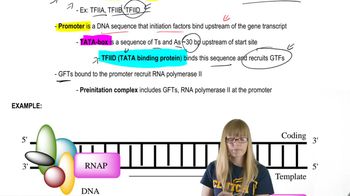
Eukaryotic Transcription

Gene Expression Regulation

Gene expression regulation refers to the mechanisms that control the timing and amount of gene expression in a cell. This regulation can occur at various stages, including transcription, RNA processing, and translation. Enhanceosomes play a significant role in this process by enhancing the transcription of specific genes, thereby influencing cellular functions and responses.
Recommended video:
Guided course
02:09
Penetrance and Expressivity