Pearson+ LogoPearson+ Logo
Ch. 13 - Regulation of Gene Expression in Eukaryotes
Sanders - Genetic Analysis: An Integrated Approach 3rd Edition
Sanders3rd EditionGenetic Analysis: An Integrated ApproachISBN: 9780135564172Not the one you use?Change textbook
Chapter 13, Problem 2c

Describe and give an example (real or hypothetical) of each of the following:
Silencer sequence action

Verified step by step guidance
1
Understand the concept of a silencer sequence: A silencer is a DNA sequence that can bind regulatory proteins (repressors) to inhibit the transcription of a gene. It is the opposite of an enhancer, which promotes transcription.
Explain the mechanism of action: Silencer sequences are typically located upstream, downstream, or within the gene they regulate. When a repressor protein binds to the silencer, it prevents the assembly of the transcription machinery at the promoter or interferes with the activity of activator proteins bound to enhancers.
Provide a real or hypothetical example: A real example is the NRSE (neuron-restrictive silencer element), which is bound by the NRSF (neuron-restrictive silencer factor) to repress the expression of neuronal genes in non-neuronal cells. Hypothetically, if a gene responsible for producing a specific enzyme in liver cells is expressed inappropriately in muscle cells, a silencer sequence could bind a repressor protein to prevent this misexpression.
Discuss the biological significance: Silencer sequences are crucial for ensuring that genes are expressed in the right cells, at the right time, and in the correct amounts. They contribute to the regulation of gene expression and the maintenance of cellular identity.
Summarize the key points: Silencer sequences act as negative regulatory elements in gene expression. They function by binding repressor proteins to inhibit transcription, ensuring proper spatial and temporal gene regulation. Examples like NRSE illustrate their role in preventing inappropriate gene expression.

Verified video answer for a similar problem:

This video solution was recommended by our tutors as helpful for the problem above.
Video duration:
3m
Was this helpful?

Key Concepts

Here are the essential concepts you must grasp in order to answer the question correctly.

Silencer Sequences

Silencer sequences are regulatory DNA elements that inhibit the transcription of specific genes. They are typically located upstream or downstream of the gene they regulate and can bind repressor proteins, which prevent the transcription machinery from accessing the gene. This action is crucial for controlling gene expression in response to various cellular signals.
Recommended video:
Guided course
08:41
Sequencing Difficulties

Transcription Regulation

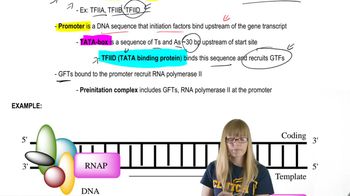
Transcription regulation refers to the mechanisms that control the rate at which genes are transcribed into RNA. This process is essential for cellular function and differentiation, allowing cells to respond to environmental changes. Silencers, along with enhancers and promoters, play a vital role in this regulation by either repressing or enhancing gene expression.
Recommended video:
Guided course
09:16
Eukaryotic Transcription

Example of Silencer Action

A classic example of silencer action can be seen in the regulation of the beta-globin gene. In certain tissues, silencer sequences can bind specific repressor proteins that prevent the expression of the beta-globin gene, ensuring that it is only expressed in the appropriate cell types, such as red blood cells. This precise control is crucial for proper hemoglobin function and overall cellular health.
Recommended video:
Guided course
07:10
Other Gene Interactions