Pearson+ LogoPearson+ Logo
Ch. 13 - Regulation of Gene Expression in Eukaryotes
Sanders - Genetic Analysis: An Integrated Approach 3rd Edition
Sanders3rd EditionGenetic Analysis: An Integrated ApproachISBN: 9780135564172Not the one you use?Change textbook
Chapter 13, Problem 2e

Describe and give an example (real or hypothetical) of each of the following:
RNA interference

Verified step by step guidance
1
Understand the concept of RNA interference (RNAi): RNA interference is a biological process in which RNA molecules inhibit gene expression or translation by neutralizing targeted mRNA molecules. This process is a natural mechanism for regulating gene expression and defending against viral infections.
Explain the mechanism of RNA interference: RNAi typically involves small RNA molecules, such as small interfering RNA (siRNA) or microRNA (miRNA). These molecules bind to complementary sequences on target mRNA, leading to its degradation or blocking its translation into protein.
Provide a real-world example: A real-world example of RNA interference is its use in research to silence specific genes in model organisms like *Caenorhabditis elegans* (a nematode). Scientists introduce double-stranded RNA (dsRNA) corresponding to the gene of interest, which triggers the RNAi pathway and silences the gene.
Provide a hypothetical example: Imagine a scenario where RNAi is used to treat a genetic disorder caused by overexpression of a harmful protein. For instance, in a hypothetical treatment for Huntington's disease, siRNA molecules could be designed to target and degrade the mRNA encoding the mutant huntingtin protein, reducing its production.
Summarize the importance of RNA interference: RNAi is a powerful tool in genetics and biotechnology, used for gene silencing, studying gene function, and developing therapeutic strategies for diseases caused by abnormal gene expression.

Verified video answer for a similar problem:

This video solution was recommended by our tutors as helpful for the problem above.
Video duration:
3m
Was this helpful?

Key Concepts

Here are the essential concepts you must grasp in order to answer the question correctly.

RNA Interference (RNAi)

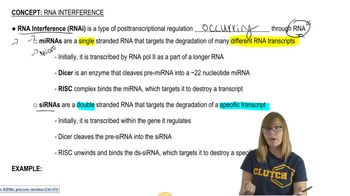
RNA interference is a biological process in which RNA molecules inhibit gene expression or translation, effectively silencing specific genes. This mechanism is crucial for regulating gene activity and defending against viral infections. RNAi is mediated by small RNA molecules, such as small interfering RNA (siRNA) and microRNA (miRNA), which bind to complementary mRNA sequences, leading to their degradation or preventing their translation.
Recommended video:
Guided course
06:59
RNA Interference

Mechanism of RNAi

The mechanism of RNA interference involves the processing of double-stranded RNA (dsRNA) into small RNA fragments by an enzyme called Dicer. These small RNA molecules then incorporate into a protein complex known as the RNA-induced silencing complex (RISC). The RISC uses the small RNA as a guide to recognize and bind to complementary mRNA, resulting in its degradation or inhibition of translation, thereby silencing the target gene.
Recommended video:

Applications of RNAi

RNA interference has significant applications in research and medicine, particularly in gene silencing and therapeutic interventions. For example, scientists can use RNAi to knock down the expression of specific genes to study their function or to develop treatments for diseases such as cancer and viral infections by targeting and silencing disease-related genes. This technology holds promise for developing novel therapies and understanding complex genetic pathways.
Recommended video:
Guided course
04:15
Artificial Selection