Pearson+ LogoPearson+ Logo
Ch. 13 - Regulation of Gene Expression in Eukaryotes
Sanders - Genetic Analysis: An Integrated Approach 3rd Edition
Sanders3rd EditionGenetic Analysis: An Integrated ApproachISBN: 9780135564172Not the one you use?Change textbook
Chapter 13, Problem 12

What are the different chromatin classifications, and what is their relationship to gene expression?

Verified step by step guidance
1
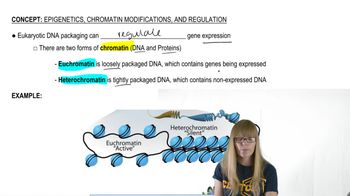
Understand that chromatin is the complex of DNA and proteins (mainly histones) that forms chromosomes within the nucleus of eukaryotic cells. Chromatin can be classified into two main types: euchromatin and heterochromatin.
Euchromatin is the less condensed form of chromatin. It is generally associated with active gene expression because the DNA is more accessible to transcription factors and RNA polymerase.
Heterochromatin is the more condensed form of chromatin. It is typically associated with gene silencing because the tightly packed structure makes the DNA less accessible to the transcriptional machinery.
Heterochromatin can be further divided into two subtypes: constitutive heterochromatin, which is always condensed and contains repetitive sequences (e.g., centromeres and telomeres), and facultative heterochromatin, which can switch between condensed and relaxed states depending on the cell's needs (e.g., the inactivated X chromosome in females).
The relationship between chromatin structure and gene expression is regulated by epigenetic modifications, such as DNA methylation and histone modifications. These modifications influence whether chromatin is in an open (euchromatin) or closed (heterochromatin) state, thereby controlling gene accessibility and expression.

Verified video answer for a similar problem:

This video solution was recommended by our tutors as helpful for the problem above.
Video duration:
3m
Was this helpful?

Key Concepts

Here are the essential concepts you must grasp in order to answer the question correctly.

Chromatin Structure

Chromatin is a complex of DNA and proteins that forms chromosomes within the nucleus of eukaryotic cells. It exists in two primary forms: euchromatin, which is loosely packed and associated with active gene expression, and heterochromatin, which is tightly packed and generally transcriptionally inactive. The structure of chromatin plays a crucial role in regulating access to DNA for transcription and replication.
Recommended video:

Gene Expression Regulation

Gene expression regulation refers to the mechanisms that control the transcription of genes, determining when and how much of a gene product is produced. This regulation can be influenced by chromatin structure, where modifications such as methylation and acetylation can either promote or inhibit access to the DNA, thereby affecting the expression of nearby genes. Understanding these regulatory mechanisms is essential for comprehending how genes are turned on or off in response to various signals.
Recommended video:
Guided course
02:09
Penetrance and Expressivity

Epigenetics

Epigenetics involves heritable changes in gene expression that do not involve alterations to the underlying DNA sequence. These changes can be influenced by environmental factors and can affect chromatin structure through chemical modifications. Epigenetic mechanisms, such as DNA methylation and histone modification, play a significant role in determining chromatin classifications and, consequently, the expression of genes, linking environmental influences to genetic outcomes.
Recommended video: