Pearson+ LogoPearson+ Logo
Ch. 13 - Regulation of Gene Expression in Eukaryotes
Sanders - Genetic Analysis: An Integrated Approach 3rd Edition
Sanders3rd EditionGenetic Analysis: An Integrated ApproachISBN: 9780135564172Not the one you use?Change textbook
Chapter 13, Problem 9

Compare and contrast the transcriptional regulation of GAL genes in yeast with that of the lac genes in bacteria.

Verified step by step guidance
1
Understand the context: The GAL genes in yeast and the lac genes in bacteria are both involved in the metabolism of specific sugars (galactose and lactose, respectively). However, their transcriptional regulation mechanisms differ due to the differences between eukaryotic and prokaryotic systems.
Step 1: Describe the regulation of GAL genes in yeast. In yeast, the GAL genes are regulated by a system involving activators (e.g., Gal4), repressors (e.g., Gal80), and inducers (e.g., galactose). When galactose is present, it binds to Gal3, which interacts with Gal80 to release its inhibition on Gal4. Gal4 then binds to upstream activating sequences (UAS) to promote transcription.
Step 2: Describe the regulation of lac genes in bacteria. In bacteria, the lac operon is regulated by the LacI repressor and the CAP-cAMP complex. When lactose is absent, the LacI repressor binds to the operator region, preventing transcription. When lactose is present, it is converted to allolactose, which binds to LacI, causing it to release the operator. Additionally, the CAP-cAMP complex enhances transcription when glucose levels are low.
Step 3: Compare the two systems. Both systems use regulatory proteins to control gene expression in response to the presence of specific sugars. However, the GAL system in yeast relies on activators and a more complex interplay of proteins, while the lac operon in bacteria primarily uses a repressor and an activator.
Step 4: Contrast the two systems. The GAL system operates in a eukaryotic context, involving chromatin remodeling and transcription factors, while the lac operon operates in a prokaryotic context, where transcription and translation are coupled. Additionally, the GAL system has a more modular and flexible regulatory mechanism compared to the simpler lac operon.

Verified video answer for a similar problem:

This video solution was recommended by our tutors as helpful for the problem above.
Video duration:
2m
Was this helpful?

Key Concepts

Here are the essential concepts you must grasp in order to answer the question correctly.

Transcriptional Regulation

Transcriptional regulation refers to the mechanisms that control the transcription of genes, determining when and how much of a gene product is produced. In both yeast and bacteria, this regulation is crucial for responding to environmental changes and metabolic needs. It involves various proteins, such as transcription factors, that bind to specific DNA sequences to enhance or inhibit gene expression.
Recommended video:
Guided course
09:16
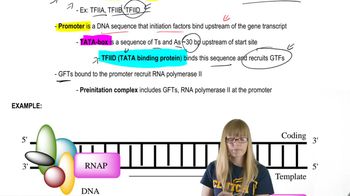
Eukaryotic Transcription

GAL Genes in Yeast

The GAL genes in yeast are involved in the metabolism of galactose and are regulated by a complex system that includes the GAL4 protein, which acts as an activator. When galactose is present, GAL4 binds to the UAS (upstream activating sequence) of the GAL genes, promoting their transcription. This regulation is an example of eukaryotic gene control, which often involves chromatin remodeling and multiple regulatory elements.
Recommended video:
Guided course
03:51
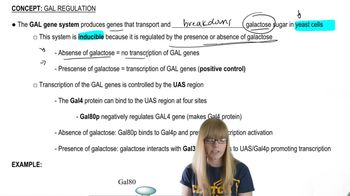
GAL Regulation

Lac Operon in Bacteria

The lac operon in bacteria, particularly E. coli, is a classic model of gene regulation that controls the metabolism of lactose. It consists of structural genes (lacZ, lacY, lacA) and is regulated by the lac repressor and CAP (catabolite activator protein). In the absence of lactose, the repressor binds to the operator, blocking transcription, while the presence of lactose and glucose levels influence the operon's activity, showcasing prokaryotic regulation mechanisms.
Recommended video:
Guided course
04:27
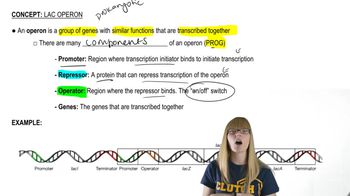
Lac Operon Overview