Pearson+ LogoPearson+ Logo
Ch. 14 - Analysis of Gene Function via Forward Genetics and Reverse Genetics
Sanders - Genetic Analysis: An Integrated Approach 3rd Edition
Sanders3rd EditionGenetic Analysis: An Integrated ApproachISBN: 9780135564172Not the one you use?Change textbook
Chapter 14, Problem C.1a

Identify the normal functions of the following genes whose mutations are associated with the development of cancer.
RB1(retinoblastoma)

Verified step by step guidance
1
Understand that the RB1 gene is a tumor suppressor gene, which means its normal function is to regulate cell cycle progression and prevent uncontrolled cell division.
Recognize that the RB1 protein plays a critical role in controlling the transition from the G1 phase to the S phase of the cell cycle by inhibiting E2F transcription factors, which promote DNA replication.
Note that when RB1 is functioning normally, it binds to E2F and keeps it inactive, thereby preventing cells from prematurely entering the DNA synthesis phase.
Realize that mutations in RB1 lead to loss of this regulatory function, allowing cells to divide uncontrollably, which contributes to the development of cancers such as retinoblastoma.
Summarize that the normal function of RB1 is to act as a gatekeeper in the cell cycle, ensuring cells only divide when appropriate, thus maintaining genomic stability.

Verified video answer for a similar problem:

This video solution was recommended by our tutors as helpful for the problem above.
Video duration:
2m
Was this helpful?

Key Concepts

Here are the essential concepts you must grasp in order to answer the question correctly.

Tumor Suppressor Genes

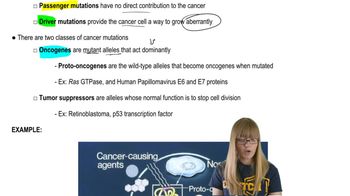
Tumor suppressor genes produce proteins that regulate cell growth and division, preventing uncontrolled proliferation. When these genes, like RB1, are mutated or inactivated, cells can grow uncontrollably, leading to cancer development.
Recommended video:
Guided course
09:09
Mapping Genes

Function of the RB1 Gene

The RB1 gene encodes the retinoblastoma protein (pRB), which controls the cell cycle by inhibiting progression from the G1 to S phase. It acts as a checkpoint to prevent excessive cell division, and loss of its function removes this control, promoting tumor formation.
Recommended video:
Guided course
08:26
Functional Genomics

Mechanism of Cancer Development via Gene Mutation

Mutations in genes like RB1 disrupt normal cellular functions, such as cell cycle regulation, DNA repair, or apoptosis. This disruption allows abnormal cells to survive and proliferate, contributing to cancer initiation and progression.
Recommended video:
Guided course
04:46
Cancer Mutations
Related Practice
Textbook Question

Go to the National Institute for Child Health and Human Development (http://www.nichd.nih.gov), locate the search box at the top right corner of the homepage, and enter 'RUSP' to search for information on the Recommended Uniform Screening Panel. From the options that appear, select 'Brief History of Newborn Screening' and locate the discussion listing the criteria for adding a disease to the RUSP list. What are the criteria for listing a disease on the RUSP list?

424
views
Textbook Question

What are community-based genetic screening programs? What is the intent of such screening programs? Why are members of specific communities or populations offered the chance to participate in such programs?

550
views
Textbook Question

Do you think it is important that participation in community-based genetic screening be entirely voluntary? Why or why not?

479
views
Textbook Question

Identify the normal functions of the following genes whose mutations are associated with the development of cancer.

p53(Li–Fraumeni syndrome)

576
views
Textbook Question

For the retinal cancer retinoblastoma, the inheritance of one mutated copy of RB1 from one of the parents is often referred to as a mutation that produces a 'dominant predisposition to cancer.' This means that the first mutation does not produce cancer but makes it very likely that cancer will develop.

Explain why cancer is almost certain to develop with the inheritance of one mutated copy of RB1.

576
views
Textbook Question

Identify the normal functions of the following genes whose mutations are associated with the development of cancer.

Which of these genes would you classify as a proto-oncogene and which as a tumor suppressor gene? Explain your categorization for each gene.

536
views