Pearson+ LogoPearson+ Logo
Ch. 14 - Analysis of Gene Function via Forward Genetics and Reverse Genetics
Sanders - Genetic Analysis: An Integrated Approach 3rd Edition
Sanders3rd EditionGenetic Analysis: An Integrated ApproachISBN: 9780135564172Not the one you use?Change textbook
Chapter 14, Problem C.1e

Identify the normal functions of the following genes whose mutations are associated with the development of cancer.
Which of these genes would you classify as a proto-oncogene and which as a tumor suppressor gene? Explain your categorization for each gene.

Verified step by step guidance
1
Step 1: Understand the roles of the two main categories of genes involved in cancer: proto-oncogenes and tumor suppressor genes. Proto-oncogenes normally promote cell growth and division, while tumor suppressor genes inhibit cell division or promote apoptosis (programmed cell death).
Step 2: For each gene mentioned, research or recall its normal biological function. Determine if the gene's product typically acts to stimulate cell proliferation (suggesting it is a proto-oncogene) or to restrain cell growth and maintain genomic integrity (suggesting it is a tumor suppressor gene).
Step 3: Identify mutations associated with cancer for each gene. If mutations lead to a gain of function that causes excessive cell division, classify the gene as a proto-oncogene. If mutations cause a loss of function that removes growth inhibition, classify it as a tumor suppressor gene.
Step 4: Provide a clear explanation for each gene's classification by linking its normal function to how mutations disrupt cellular regulation and contribute to cancer development.
Step 5: Summarize the classification by listing each gene with its normal function, mutation effect, and whether it is a proto-oncogene or tumor suppressor gene, ensuring the reasoning is clear and based on the gene's role in cell cycle control.

Verified video answer for a similar problem:

This video solution was recommended by our tutors as helpful for the problem above.
Video duration:
3m
Was this helpful?

Key Concepts

Here are the essential concepts you must grasp in order to answer the question correctly.

Proto-oncogenes

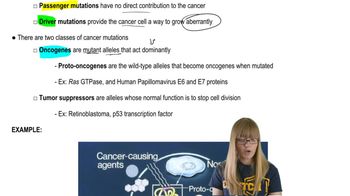
Proto-oncogenes are normal genes that promote cell growth and division. When mutated or overexpressed, they become oncogenes that can lead to uncontrolled cell proliferation, contributing to cancer development. Examples include genes encoding growth factors, receptors, and signaling proteins.
Recommended video:
Guided course
04:46
Cancer Mutations

Tumor Suppressor Genes

Tumor suppressor genes normally inhibit cell division, repair DNA damage, or initiate apoptosis to prevent tumor formation. Mutations that inactivate these genes remove growth restraints, allowing cells to proliferate uncontrollably. Classic examples include TP53 and RB1.
Recommended video:
Guided course
09:09
Mapping Genes

Gene Mutation and Cancer Classification

Classifying genes as proto-oncogenes or tumor suppressors depends on their normal function and mutation effects. Gain-of-function mutations typically activate proto-oncogenes, while loss-of-function mutations inactivate tumor suppressor genes. Understanding these distinctions is key to linking gene mutations with cancer mechanisms.
Recommended video:
Guided course
04:46
Cancer Mutations