Pearson+ LogoPearson+ Logo
Ch. 14 - Analysis of Gene Function via Forward Genetics and Reverse Genetics
Sanders - Genetic Analysis: An Integrated Approach 3rd Edition
Sanders3rd EditionGenetic Analysis: An Integrated ApproachISBN: 9780135564172Not the one you use?Change textbook
Chapter 14, Problem C.1b

Identify the normal functions of the following genes whose mutations are associated with the development of cancer.
c-MYC(Burkitt lymphoma)

Verified step by step guidance
1
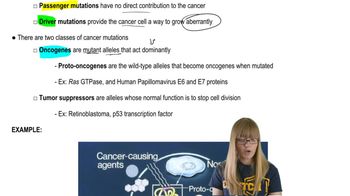
Understand that c-MYC is a proto-oncogene, which means its normal function is to regulate cell growth and division by encoding a transcription factor that controls the expression of genes involved in cell cycle progression.
Recognize that in normal cells, c-MYC helps promote controlled cell proliferation and apoptosis, maintaining a balance necessary for healthy tissue function.
Note that mutations or translocations involving c-MYC, such as those seen in Burkitt lymphoma, lead to its overexpression, causing uncontrolled cell division and contributing to cancer development.
Summarize that the normal function of c-MYC is to act as a regulator of gene expression that promotes cell growth, differentiation, and apoptosis under tight control.
Conclude that understanding the normal role of c-MYC helps explain how its dysregulation through mutation or translocation can lead to oncogenesis.

Verified video answer for a similar problem:

This video solution was recommended by our tutors as helpful for the problem above.
Video duration:
2m
Was this helpful?

Key Concepts

Here are the essential concepts you must grasp in order to answer the question correctly.

Oncogenes and Proto-oncogenes

Proto-oncogenes are normal genes that regulate cell growth and division. When mutated or abnormally expressed, they become oncogenes that can promote uncontrolled cell proliferation, leading to cancer. Understanding the role of proto-oncogenes like c-MYC is essential to grasp how their mutations contribute to tumor development.
Recommended video:
Guided course
04:46
Cancer Mutations

Function of c-MYC Gene

The c-MYC gene encodes a transcription factor that regulates the expression of genes involved in cell cycle progression, metabolism, and apoptosis. Normally, c-MYC controls cell growth and proliferation, but its overexpression or mutation can drive oncogenesis, as seen in Burkitt lymphoma.
Recommended video:
Guided course
08:26
Functional Genomics

Molecular Basis of Burkitt Lymphoma

Burkitt lymphoma is characterized by a chromosomal translocation involving c-MYC, leading to its deregulated expression. This translocation places c-MYC under the control of immunoglobulin gene enhancers, causing excessive cell proliferation in B lymphocytes and contributing to cancer development.
Recommended video:
Guided course
07:11
Mapping with Markers
Related Practice
Textbook Question

Identify the normal functions of the following genes whose mutations are associated with the development of cancer.

Which of these genes would you classify as a proto-oncogene and which as a tumor suppressor gene? Explain your categorization for each gene.

536
views
Textbook Question

Identify the normal functions of the following genes whose mutations are associated with the development of cancer.

APC(familial adenomatous polyposis)

512
views
Textbook Question

Explain the following processes involving chromosome mutations and cancer development.

How the chromosome mutation producing the Philadelphia chromosome leads to CML.

579
views
Textbook Question

Go to the website http://www.cancer.gov and select 'Cancer Types' on the top menu bar. Scroll down to 'Breast Cancer' and click. Select 'Cases & Prevention' from the options. Click 'More information' and select 'BRCA Mutations: Cancer Risk and Genetic Testing'. Use the information on this page to answer the following questions. As a special project, instead of selecting 'Breast Cancer' from the list of types of cancer, select another cancer you would like to know more about and produce a short summary of what you find.

488
views
Textbook Question

What kind of information will be made available by The Cancer Genome Atlas (TCGA)? What sort of role do you think TCGA information will play in cancer diagnosis and cancer treatment in the future?

618
views
Textbook Question

Go to the website http://www.ncbi.nlm.nih.gov/omim and enter 'Lynch syndrome' in the Search box at the top of the page. From the list of options given, select '#120435—Lynch Syndrome.' Use the information you retrieve to answer the following questions. There are two types of Lynch syndrome. What are they?

454
views