Pearson+ LogoPearson+ Logo
Ch. 15 - Recombinant DNA Technology and Its Applications
Sanders - Genetic Analysis: An Integrated Approach 3rd Edition
Sanders3rd EditionGenetic Analysis: An Integrated ApproachISBN: 9780135564172Not the one you use?Change textbook
Chapter 15, Problem E.10a

The frequencies of the four alleles contributed to the child by possible father F1 in Problem 7 are 0.18, 0.23, 0.13, and 0.14. Calculate the Combined Paternity Index (CPI) for the four genes in this analysis.

Verified step by step guidance
1
Understand that the Combined Paternity Index (CPI) is the product of the Paternity Indices (PIs) for each gene or allele tested. The PI for each gene is calculated based on the allele frequency contributed by the alleged father.
Recall that the Paternity Index (PI) for a single allele is calculated as the reciprocal of the allele frequency if the alleged father is homozygous for that allele, or as 1 divided by twice the allele frequency if the alleged father is heterozygous. Since the problem only provides allele frequencies, assume the simplest case where PI = 1 / allele frequency for each allele.
Write down the allele frequencies given: f_1=0.18, f_2=0.23, f_3=0.13, f_4=0.14.
Calculate the PI for each allele using the formula PI_i = 1 / f_i. This means you will compute PI_1 = 1/0.18, PI_2 = 1/0.23, PI_3 = 1/0.13, and PI_4 = 1/0.14.
Multiply all the individual PIs together to get the Combined Paternity Index: CPI = PI_1 \times PI_2 \times PI_3 \times PI_4. This product gives the overall likelihood ratio supporting paternity based on the four alleles.

Verified video answer for a similar problem:

This video solution was recommended by our tutors as helpful for the problem above.
Video duration:
3m
Was this helpful?

Key Concepts

Here are the essential concepts you must grasp in order to answer the question correctly.

Allele Frequency

Allele frequency refers to how common a specific allele is within a population. It is expressed as a proportion or percentage and is crucial in genetic analyses to estimate the likelihood of an individual carrying a particular allele. In paternity testing, allele frequencies help calculate the probability that a random individual from the population could contribute the observed alleles.
Recommended video:
Guided course
03:03
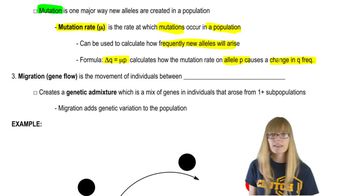
New Alleles and Migration

Paternity Index (PI)

The Paternity Index is a likelihood ratio that compares the probability of the alleged father transmitting a specific allele to the child versus a random man from the population. It is calculated for each genetic marker and reflects how strongly the genetic evidence supports paternity. A higher PI indicates stronger evidence that the tested man is the biological father.
Recommended video:

Combined Paternity Index (CPI)

The Combined Paternity Index is the product of individual Paternity Indices across multiple genetic loci. It aggregates the evidence from all tested markers to provide an overall likelihood ratio supporting paternity. The CPI is used to calculate the probability of paternity, with higher values indicating stronger genetic evidence that the tested man is the biological father.
Recommended video:
Guided course
09:30
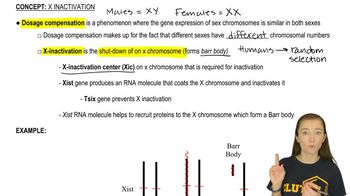
X-Inactivation
Related Practice
Textbook Question

Explain the meaning of 'identity by descent' in the context of identifying genealogical relationship between individuals. In these analyses, why are segments of chromosomes (haplotypes) rather than individual STRs used to identify genetic relationships?

665
views
Textbook Question

Figure E.1 illustrates the results of an electrophoretic analysis of 13 CODIS STR markers on a DNA sample and identifies the alleles for each gene. Table E.2 lists the frequencies for alleles of three of the STRs shown in the figure. Use this information to calculate the frequency of the genotype for STR genes FGA, vWA, and D3S1358 given in Figure E.1.

597
views
Textbook Question

Additional STR allele frequency information can be added to improve the analysis in Problem 8. The frequency of D8S1179₁₂ = 0.12. The frequency of D16S539₁₈ = 0.08 and of D16S539₂₀ = 0.21. Lastly, D18S51₁₉ = 0.13 and D18S51₂₀ = 0.10. Combine the allele frequency information for these three STR genes with the information used in Problem 8 to calculate the frequency of the genotype for six of the STR genes.

504
views
Textbook Question

The frequencies of the four alleles contributed to the child by possible father F1 in Problem 7 are 0.18, 0.23, 0.13, and 0.14. Make a statement about the possible paternity of F1 based on this analysis.

456
views
Textbook Question

In an inheritance case, a man has died leaving his estate to be divided equally between 'his wife and his offspring.' His wife (M) has an adult daughter (D), and they argue that they should split the estate equally. As a young couple, however, the man and his wife had a son that they gave up for adoption. Two men have appeared, each claiming to be the son of the couple and therefore entitled to a one-third share of the estate. The accompanying illustration shows the results of DNA analysis for five genes for the mother (M), her daughter (D), and the two claimants (S1 and S2). How many nonmaternal DNA bands are shared by D and S1? By D and S2?

541
views
Textbook Question

Three independently assorting STR markers (A, B, and C) are used to assess the paternity of a colt recently born to a quarter horse mare. Blood samples are drawn from the mare, her colt, and three possible male sires (S₁, S₂, and S₃). DNA at each marker locus is amplified by PCR, and a DNA electrophoresis gel is run for each marker. Amplified DNA bands are visualized in each gel by ethidium bromide staining. Gel results are shown below for each marker. Evaluate the data and determine if any of the potential sires can be excluded. Explain the basis of exclusion, if any, in each case.

635
views